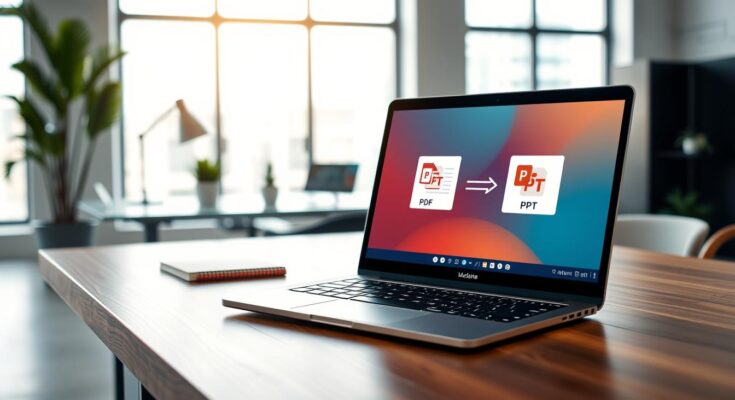
Have you ever felt frustrated when you had to rebuild a presentation from a static document? It should be easy to transform your files, not a chore.
A top-notch pdf to ppt converter online free lets you turn static pages into editable slides quickly. This makes a solid base for your work. But, you might need to tweak complex graphics or unique fonts later.
PDFgear gives you a secure, professional way to convert files. It doesn’t ask for registrations, watermarks, or hidden fees. It’s made to save you time and keep your documents looking great.
Key Takeaways
- Automate the transition from static documents to dynamic slide decks.
- Save valuable time by avoiding manual data entry and formatting.
- Utilize tools that require no registration or intrusive advertisements.
- Enjoy a watermark-free experience for polished, professional results.
- Review your output to ensure complex graphics align with your vision.
Turn PDF Files Into Editable PowerPoint Presentations Online
Today’s digital tools make it easy to change static PDFs into interactive slide decks. When you convert pdf to ppt online, you turn a fixed document into something you can edit. This lets users create dynamic visual content beyond the limits of read-only files.
What a PDF to PPT conversion actually changes
A good pdf to powerpoint converter breaks down your document into its parts. It tries to pull out text, layout, and images, putting them into PowerPoint slides. But, some complex graphics might stay as images.
The main goal is to give you an editable powerpoint presentation that you can change as you need. Most text becomes editable, but some complex formatting might need a little manual fix.
Who benefits from converting PDFs to PowerPoint
Many people, including professionals and students, use this tech to save time. It lets them reuse documents instead of starting from scratch.
Students and educators preparing presentations
Teachers often have PDFs of lesson plans or handouts. Converting these files helps them make engaging classroom slides quickly, without retyping everything.
Business teams updating reports and proposals
Corporate teams often get reports in PDF. With a good tool, they can pull out important data and charts for their slide decks.
Freelancers and presenters reusing client documents
Freelancers often work with PDFs from clients. This conversion lets them use the client’s branding and messaging in new presentations.
| Document Type | Conversion Result | Primary Benefit |
|---|---|---|
| Text-heavy Reports | High Editability | Fast content updates |
| Graphic Brochures | Mixed Layout | Visual consistency |
| Data Tables | Reconstructed Cells | Easy number editing |
Why Use a PDF to PPT Converter Online Free
Today’s professionals need quick ways to manage documents without heavy software. An online pdf converter makes it easy to turn static documents into dynamic slides. These tools use the cloud, so you don’t have to deal with software setup.
Convert files without installing desktop software
Using a free pdf converter keeps your computer clean. You don’t need to download or install software to change a file. This saves space and avoids system conflicts.
Save time when rebuilding slides manually
Turning a document into a presentation can be slow and full of mistakes. A good pdf to pptx converter makes it easy by extracting text and images. This lets you focus on your message, not formatting.
Access the tool from Windows, Mac, Chromebook, or mobile devices
Browser-based tools are great for those on the move. You can use them on Windows, Mac, Chromebook, or mobile devices. This means you can work anywhere, anytime.
Understand the trade-offs between convenience and advanced controls
Online converters are easy to use but have limits compared to desktop software. They’re fast but might not offer the detailed editing you need. Think about what you need for your project before choosing.
| Feature | Online Converter | Desktop Software |
|---|---|---|
| Installation | None Required | Full Installation |
| Accessibility | Any Browser/Device | Device Specific |
| Internet Need | Required | Not Required |
| Advanced Editing | Limited | Extensive |
How the PDF to PPT Conversion Process Works
Today’s tools use advanced tech to turn fixed documents into editable slides. They automate data extraction, making it easy to reuse content without starting over.
Upload the PDF file securely
First, choose your document and upload it to a secure server. Data privacy is a priority. The platform uses encrypted connections to keep your info safe. After upload, the system gets ready for analysis.
Let the converter detect pages, text, images, and layout elements
The software scans your document deeply to find all parts. It spots text, headers, footers, and graphics to keep the layout. This step is key for a polished and professional presentation.
Download the generated PowerPoint file
After scanning, the tool turns the data into a new presentation. You’ll get a prompt to download your file. This usually takes just a few moments, depending on your document’s size.
Open the presentation and review the converted slides
After downloading, open the file in your presentation software. It’s vital to review every slide to check if everything is right. While the tool is very accurate, you might need to tweak font sizes or image positions.
Why complex PDFs may require additional processing time
Files with complex layouts or many images need more time. Patience is key for large or detailed documents.
How scanned PDFs differ from text-based PDFs
Text-based PDFs are easy for the software to read. But scanned PDF to PPT conversions need OCR tech. This tech reads text in images, unlike standard PDFs.
How to Convert a PDF to PPT Online
Turning a PDF into a dynamic slide deck is easy. Use a PDF to PPT tool to get professional results without software. This quick method saves time and keeps your work flowing smoothly.
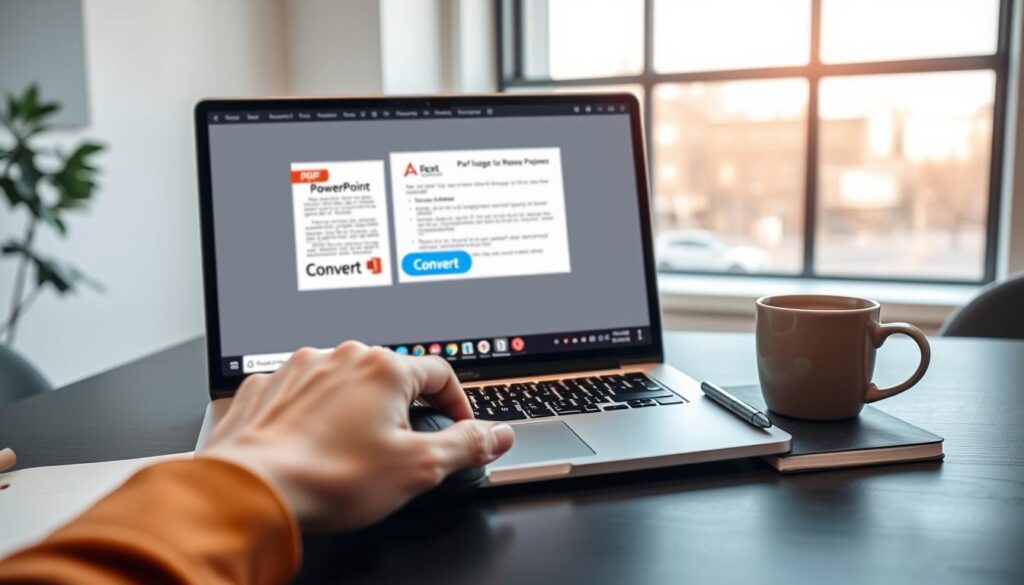
Choose a trustworthy online converter
First, pick a reliable service that values your privacy and document safety. A good platform lets you convert PDF to PPT online no email. Make sure to check their terms to see how they handle your data.
Upload a single PDF or select the supported batch option
After picking your tool, find the upload area on the homepage. You can drag and drop your file into the browser. Many tools also support batch processing for converting several documents at once.
Select PowerPoint as the output format
After uploading, make sure it’s set to export as a PowerPoint file. If your document has images or scanned pages, look for OCR. This feature is essential for making static images editable in your slides.
Start the conversion and wait for processing to finish
Click the convert button to start the process. The server will then analyze your document. This usually takes just a few moments, depending on the file size and complexity.
Download and rename the presentation for easy organization
Once it’s done, save the file to your computer. Rename it right away to keep your files organized. A clear name makes it easy to find your presentation later.
Check the file extension before opening the download
Before opening, check if the file ends in .pptx or .ppt. This ensures it’s compatible with your presentation software. If the extension is wrong, the file might not open correctly.
Repeat the process when a conversion is interrupted
Internet issues can sometimes stop the upload or download. If this happens, just refresh your browser and try again. Most tools handle these issues smoothly.
| Step | Action | Benefit |
|---|---|---|
| 1 | Upload File | Quick access |
| 2 | Select Format | High compatibility |
| 3 | Convert | Automated layout |
| 4 | Download | Ready to edit |
What Makes an Online PDF to PowerPoint Tool Reliable
Transforming static files into dynamic slides requires a reliable tool. Users often look for a convert PDF to PPT on Mac solution. It should balance speed with high-quality output.
A good tool works well with complex documents. It ensures your original document’s quality is maintained.
Accurate text recognition and editable content
A reliable converter uses Optical Character Recognition (OCR) well. This technology captures text as fully editable characters, not just images. High-quality tools have fewer errors, making it easy to edit content after conversion.
Preserved fonts, spacing, colors, and slide proportions
A top converter keeps your file’s visual integrity. Whether you’re using convert PDF to PPT on Windows or another system, the layout stays the same. It ensures your fonts, margins, and colors are accurate in the new slide format.
Clear handling of images, charts, tables, and graphics
Documents with complex data visualizations are a challenge. A great tool correctly places these elements in PowerPoint slides. Precision in handling graphics avoids common issues like overlapping text or distorted charts.
Consistent results across short and lengthy PDF documents
Reliability is tested with files of all lengths. Whether it’s a single-page handout or a fifty-page report, quality should be consistent. Using a PDF to PPT for Chromebook tool, you should see the same detail in long documents as in short ones.
Transparent limits for file size, page count, and daily usage
Trustworthy services clearly state their limits. Before starting, check for these signs of a reliable platform:
- File Size Caps: Clear documentation on the maximum megabytes allowed per upload.
- Page Limits: Defined restrictions on how many pages can be processed in a single session.
- Usage Policies: Open communication regarding daily conversion quotas for free users.
- Batch Processing: Availability of features that allow multiple files to be handled simultaneously.
How to Protect Your Files When Converting PDFs Online
Before you upload any file to a web-based converter, it’s important to know how your info is handled. Getting secure PDF conversion means being proactive and understanding data management.
Check the service’s privacy policy and file-retention practices
Always read the privacy policy of any website you plan to use. Look for details on how long they keep your files before deleting them.
Good services tell you how long they keep your files. Transparency is key for a trustworthy provider. Stay away from sites that don’t clearly state their data policies.
Avoid uploading confidential documents to unknown websites
Not all online tools are safe for your data. Be careful and don’t upload sensitive files to unknown or untrusted sites.
Use secure connections and confirm the site uses HTTPS
A secure connection is essential for data safety. Make sure the website starts with “HTTPS” to know your data is encrypted.
Delete uploaded and converted files when the service allows it
Many platforms let you delete files after use. Always delete your files right after downloading to keep your PDF conversion privacy safe.
Extra precautions for financial, legal, medical, and client documents
Handling sensitive info like medical records or legal contracts is risky. It’s highly recommended to avoid cloud processing for these documents to prevent unauthorized access.
When an offline converter is the safer choice
For strict confidentiality, an offline converter is better. Offline software works on your computer, not online.
This way, your files stay on your computer. It’s the safest option for PDF conversion privacy. Your data never goes online, avoiding risks of internet transfers and server storage.
Common Conversion Problems and Practical Fixes
Online tools are super handy, but sometimes they don’t work perfectly. Getting your PDF to PPT formatting just right can be tricky. This is because how complex your original document is affects the final look.
Text appears as an image instead of editable text
It’s common for the converter to treat your text as a picture instead of something you can edit. This usually happens with scanned documents or images that have been flattened.
Fonts change or lines wrap differently
When your document uses special fonts, the converter might change them to standard fonts. This can mess up the text, making it look awkward or spaced out wrong.
Tables and charts lose their original alignment
Converting complex data can be tough. Tables might lose their borders, and charts could get their labels mixed up. You’ll need to fix these in PowerPoint by hand.
Images look blurry or move out of place
Images can lose quality if the converter compresses them too much. Also, images in the PDF might not stay where they’re supposed to on the PowerPoint slide.
Pages convert with incorrect slide dimensions
If your PDF has an unusual page size, the converter might have trouble fitting it into a PowerPoint slide. This can lead to white bars or stretched content that you’ll need to resize manually.
Use OCR for scanned or image-only PDFs
If your text is not editable, use Optical Character Recognition (OCR). It turns visual data into text you can edit.
Replace missing fonts and adjust slide layouts manually
When fonts don’t match, just pick the text in PowerPoint and change it to your preferred font. You might also need to move text boxes to make the layout look good.
Export selected pages again when only part of the file is affected
If only a few slides are the problem, don’t convert the whole document. Take out those specific pages from the PDF and convert them one by one to save time.
Before starting, always check the PDF to PPT file size limit. Most free services have a 100 MB limit. Going over this can stop the process before you even see any formatting issues.
| Issue Type | Primary Cause | Recommended Fix |
|---|---|---|
| Non-editable text | Scanned document | Apply OCR tool |
| Layout shifts | Complex formatting | Manual adjustment |
| File failure | Exceeding 100 MB limit | Compress PDF first |
| Font errors | Missing system fonts | Update slide styles |
How to Improve the Converted PowerPoint Before Presenting
After converting your PowerPoint, see it as a starting point, not the final version. Automated tools are great, but they can’t replace the human touch needed for a professional presentation. Taking time to edit converted PowerPoint files makes sure your message is clear and impactful.

Review every slide for formatting and content accuracy
Begin by checking each slide to make sure the text and data are correct. Automated systems might miss complex layouts, so double-check numbers and bullet points. Accuracy is key for a credible presentation.
Apply a consistent theme, font pairing, and color palette
Once you’ve checked the content, focus on PowerPoint slide formatting. Use a standard theme from the design tab to make all slides look the same. This simple step makes your presentation look professional and branded.
Resize text boxes, images, and charts for better readability
Converted elements might not fit right after the transition. Adjust the size and position of text boxes and images to balance them. If unsure, you can learn more about optimizing your file for high quality.
Remove unnecessary pages and combine repetitive slides
PDFs often have extra pages like cover sheets or legal disclaimers. Delete these to keep your message focused. Combining similar slides into one makes your presentation flow better.
Add speaker notes, transitions, and presentation-specific messaging
A great presentation is about the story you tell, not just the visuals. Use speaker notes for your talking points and cues. Subtle transitions help guide your audience through the information.
Use PowerPoint’s Slide Master for fast, consistent edits
Use the Slide Master feature for quick, global changes. It lets you update fonts, logos, and colors across all slides at once. It’s the best way to keep PowerPoint slide formatting consistent.
Check the presentation on the screen and device used for delivery
Always test your presentation on the actual device you’ll use. Different screens or software versions can change how it looks. A quick rehearsal on the target device prevents last-minute surprises and boosts your confidence when editing converted PowerPoint for the stage.
Free Online Conversion Compared With Paid and Desktop Tools
Choosing the right file conversion tool is all about finding the right balance. Some people want speed, while others need to protect their data. Knowing the strengths of each type helps you pick the best tool for your needs.
When a free online converter is the right option
Free online tools are great for occasional tasks where speed matters most. They let you convert files quickly without needing to install anything. They’re perfect for students or anyone who needs a simple conversion now and then.
When paid software provides better value
Paid tools are better for those who work with lots of data or need precise results. They often have features like Optical Character Recognition (OCR) to make scanned images editable. If you’re making presentations for clients, you’ll want the quality that paid software offers.
How desktop applications handle privacy and offline work
A PDF to PPT offline converter keeps your data safe by working on your computer only. This is key for keeping sensitive info secure. Plus, these apps work even when you’re not online, making them reliable anywhere.
Compare important features before choosing a tool
Choosing the right tool means looking at what it can do, not just its name. Think about what you need every day, whether you’re working alone or with a team.
File limits, OCR, batch conversion, and editing controls
For those who need to convert many files at once, PDF to PPT batch conversion is a must. Professional software doesn’t limit file sizes or pages like free tools do. It also lets you tweak your slides before they’re final.
Output quality, processing speed, and customer support
Top-notch tools keep your documents looking good, even with complex layouts. While online tools are quick, they might struggle with detailed graphics or big files. Plus, software with customer support means you can get help when you need it, keeping your projects on track.
| Feature | Free Online Tool | Paid Desktop Software |
|---|---|---|
| Privacy | Cloud-based processing | Local, offline security |
| Batch Processing | Limited or unavailable | High-volume support |
| OCR Capability | Basic or absent | Advanced text recognition |
| Internet Need | Required | Not required |
Best Practices for Better PDF to PPT Results
Getting your files ready right is key to a smooth transition from static to dynamic presentations. A few proactive steps can help avoid formatting errors and save time in the final design phase.
Start with a clean, high-resolution source PDF
The quality of your output depends on the quality of your input. Always use a high-resolution PDF without noise, scan artifacts, or skewed text. This ensures the conversion engine can accurately read layouts and fonts.
Use text-based PDFs whenever editable content matters
For editable content, choose a text-based PDF over a scanned image. Digital documents from word processors keep character data for easy conversion. If you have a scanned document, OCR it first for editable text.
Keep the original file as a reference during editing
It’s smart to keep your source document open while editing. This lets you check complex layouts or data points that might change during PDF to PPT conversion. Having the original ensures no important info is lost or misread.
Convert only the pages needed for a focused presentation
Not every page in a long report is needed for a presentation. If your document is long, pick only the pages you want to present. This saves time and keeps your presentation clean.
Proofread numbers, names, links, and visual details before sharing
Thorough PowerPoint proofreading is vital for your professional image. Automated tools can miss complex tables or specific names. Always check numbers, contact details, and data points to match your source perfectly.
Test hyperlinks, animations, videos, and embedded objects separately
Interactive elements need extra care after conversion. Always test your hyperlinks and check embedded media for smooth playback. This final PowerPoint proofreading step makes sure your audience has a great experience.
Who Should Use a PDF to PPT Converter Online Free
Many people use online converters to make their work easier. These tools help turn static documents into dynamic presentations. But, remember, the output is just a starting point.
Professionals turning reports into presentation decks
In business, moving from detailed reports to quick summaries is common. A PDF to PPT for business helps teams quickly convert reports to PowerPoint. This saves a lot of time for meetings or client updates.
Teachers converting lesson materials into classroom slides
Teachers often use PDF textbooks or worksheets as visual aids. By converting these, they can make engaging classroom slides. This keeps the printed and digital materials consistent.
Students adapting research papers and handouts
Students need to present complex research to their class or professor. Using PDF to PPT for students helps organize key data and charts. It’s a good way to prepare before adding the final touches.
Marketers repurposing brochures, case studies, and white papers
Marketing teams need to share brand messages across different platforms. Converting PDFs into presentations speeds up content sharing. This way, brand assets are used effectively everywhere.
Anyone who needs a quick starting point
These tools are great for saving time, but they’re not perfect. They do the hard work of layout and text, but you need to check everything. Here’s how to make sure your presentation looks good:
- Review every slide for errors or broken text.
- Proofread all numbers, names, and links for accuracy.
- Apply a consistent theme to match your brand or project style.
- Adjust images and charts to look professional on a big screen.
Conclusion
Turning static documents into dynamic presentations saves a lot of time for both professionals and students. Using a reliable PDF conversion service helps you avoid manual data entry. This way, you keep control over your project’s timeline.
Keeping your information safe is key when dealing with sensitive data. Always check the privacy policies of any platform before uploading your files. This careful step helps keep your data safe from start to finish.
Getting high-quality results depends on your attention to detail after the file is transformed. View the output as a starting point, not the final product. Reviewing your editable presentation slides carefully helps you improve the formatting and make sure the content meets your goals.
By combining smart technology with your own creative input, you achieve the best results. These tools help simplify your tasks. This lets you focus on delivering a powerful message to your audience.