Fibonacci Sequence: Numbers, Formula and the Golden Ratio
0, 1, 1, 2, 3, 5, 8…: each number is the sum of the previous two. The first 30 terms, the formula and the golden ratio.

Step-by-step maths guides: formulas, geometry, fractions, statistics and more, with worked examples.
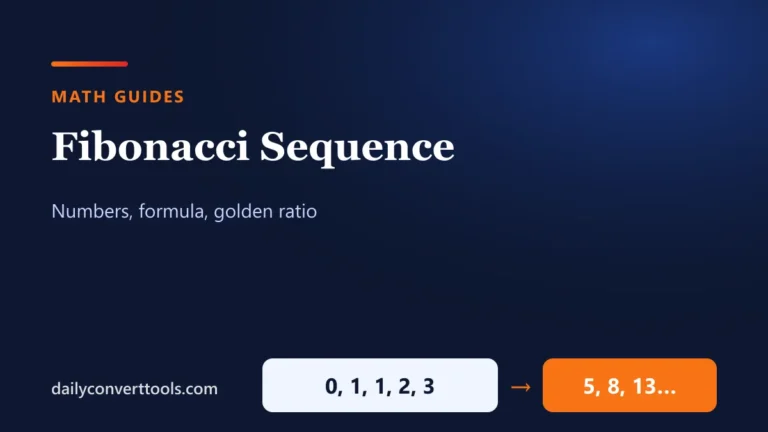
0, 1, 1, 2, 3, 5, 8…: each number is the sum of the previous two. The first 30 terms, the formula and the golden ratio.
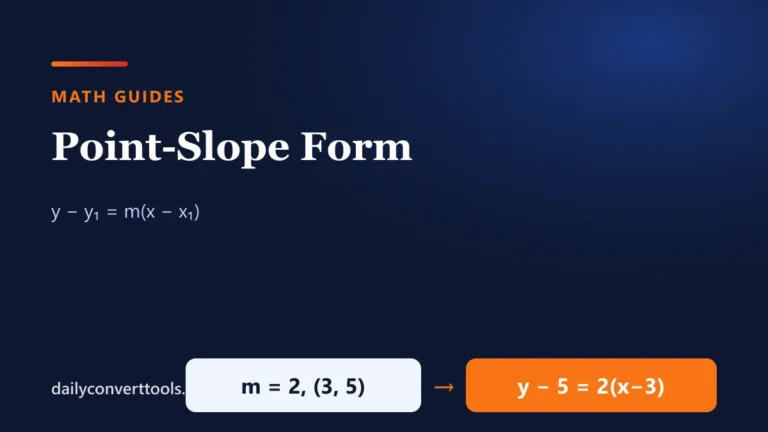
y − y₁ = m(x − x₁): write a line from a point and slope, or two points, and convert to y = mx + b.
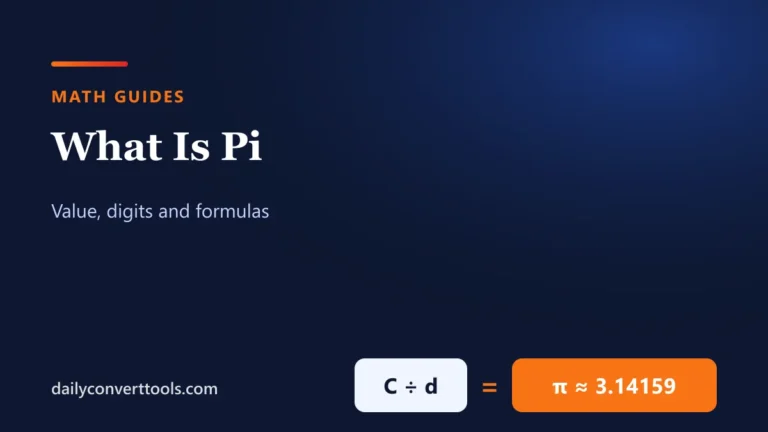
Pi is circumference ÷ diameter, about 3.14159. The first 50 digits, why it never ends, formulas and Pi Day.
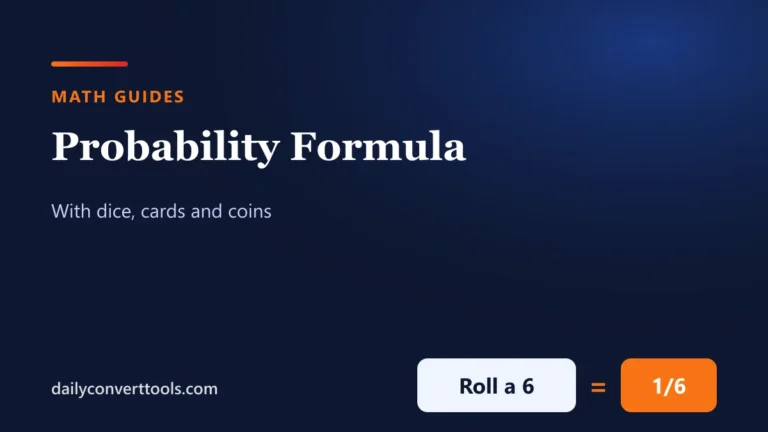
Favourable ÷ total outcomes: single events, “and” and “or” rules, and probability as odds and percentages.
The average distance from the mean. Calculate MAD step by step, compare it with standard deviation, and use Excel.
Range = largest − smallest. How to find the range and mode, what they tell you, and range vs IQR.
5! = 120: a factorial chart, why 0! = 1, and how factorials give permutations and combinations.
V = 1/3 × base area × height, for square, rectangular and triangular bases, with worked examples.
Area = length × width; perimeter = 2(l + w). Examples, missing sides, squares, and area vs perimeter.
Multiply by 180/π (radians to degrees) or π/180 (degrees to radians). 1 rad ≈ 57.30°, with a chart.