M/S to MPH (and km/h): Formula and Speed Chart
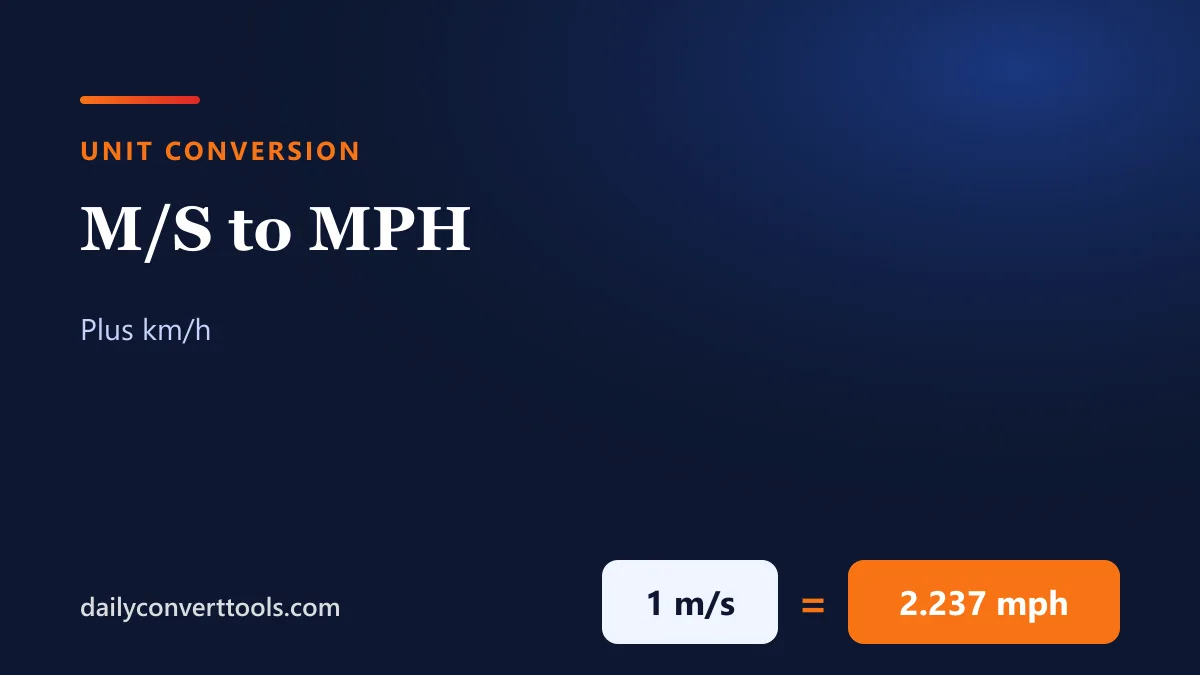
Metres per second is the scientific unit for speed, used in physics, weather and sports science. To compare it with road speeds: 1 m/s is about 2.24 mph, or exactly 3.6 km/h.
Quick answer
- mph = m/s × 2.23694
- km/h = m/s × 3.6 (exact)
- m/s = mph × 0.44704 (exact)
Both factors are exact: 1 mph = 1,609.344 m ÷ 3,600 s = 0.44704 m/s, and 1 km/h = 1,000 ÷ 3,600 m/s. The mile’s exact length comes from NIST Handbook 44, Appendix C.
M/S to mph and km/h chart
| m/s | mph | km/h |
|---|---|---|
| 1 | 2.2 | 3.6 |
| 2 | 4.5 | 7.2 |
| 3 | 6.7 | 10.8 |
| 5 | 11.2 | 18.0 |
| 8 | 17.9 | 28.8 |
| 10 | 22.4 | 36.0 |
| 12 | 26.8 | 43.2 |
| 15 | 33.6 | 54.0 |
| 20 | 44.7 | 72.0 |
| 25 | 55.9 | 90.0 |
| 30 | 67.1 | 108.0 |
| 40 | 89.5 | 144.0 |
| 50 | 111.8 | 180.0 |
| 100 | 223.7 | 360.0 |
Everyday speeds
- Walking: about 1.4 m/s (3.1 mph).
- Steady cycling: around 5–7 m/s (11–16 mph).
- A strong breeze: about 11–14 m/s (Beaufort force 6).
- Highway speed of 70 mph is 31.3 m/s.
MPH to m/s
| mph | m/s |
|---|---|
| 10 | 4.47 |
| 20 | 8.94 |
| 30 | 13.41 |
| 40 | 17.88 |
| 50 | 22.35 |
| 60 | 26.82 |
| 70 | 31.29 |
| 80 | 35.76 |
Wind speed units
Weather services use different units for wind: m/s in much of Europe and in science, km/h in many countries, mph in the US and UK, and knots at sea and in aviation. To compare forecasts, convert to one unit: for example, a gust of 20 m/s is 45 mph, 72 km/h or 39 knots.
A quick mental trick
m/s to mph: double it and add 10%. For 10 m/s: 20 + 2 = 22 mph (exact: 22.4). m/s to km/h: multiply by 3.6, or by 4 and subtract 10%.
Frequently asked questions
How many mph is 1 m/s?
2.237 mph.
How many km/h is 10 m/s?
36 km/h.
How many m/s is 60 mph?
26.82 m/s.
Why do scientists use m/s?
It’s the SI unit of speed, built from the metre and the second.