Kinetic Energy Formula (KE = ½mv²) and Potential Energy, With Examples
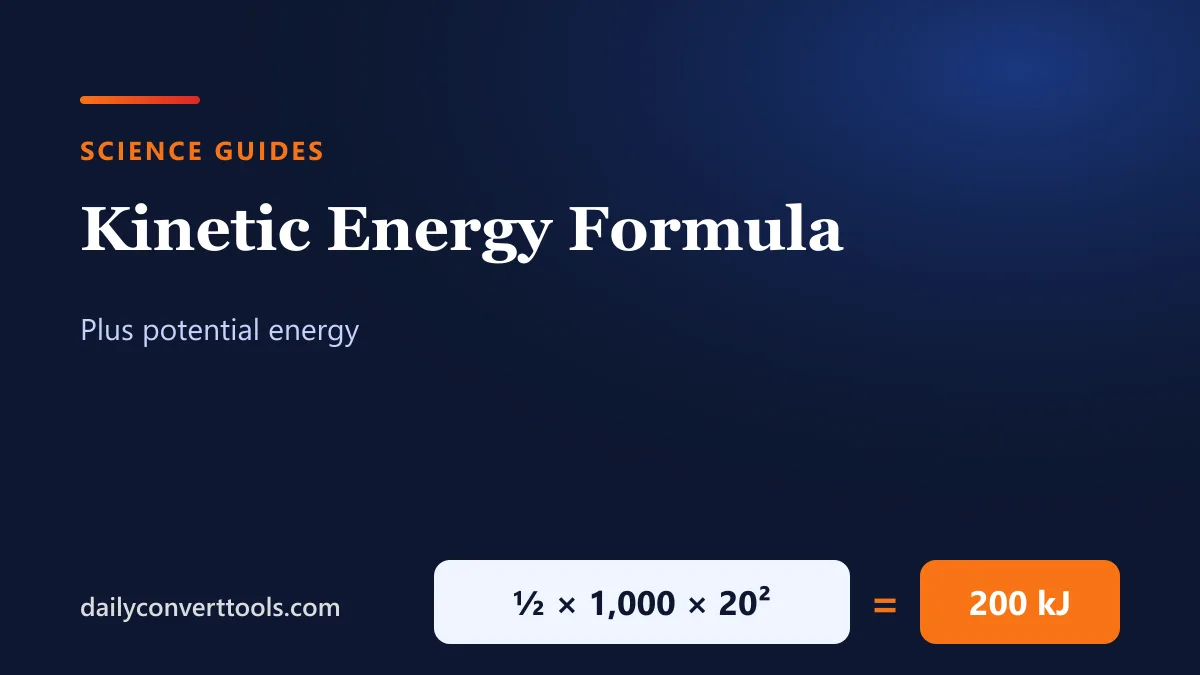
Kinetic energy is the energy an object has because it’s moving. The faster and heavier it is, the more energy it carries, and speed matters far more than mass.
Quick answer
- KE = ½ × m × v² (mass in kg, velocity in m/s, energy in joules)
- Gravitational potential energy: PE = m × g × h (g ≈ 9.81 m/s², h in metres)
- Example: a 1,000 kg car at 20 m/s has KE = ½ × 1,000 × 400 = 200,000 J (200 kJ).
Speed matters most
Because velocity is squared, doubling the speed quadruples the kinetic energy. That’s why stopping distances grow so quickly with speed.
| Car speed (1,000 kg) | m/s | Kinetic energy |
|---|---|---|
| 30 km/h | 8.3 | 35 kJ |
| 50 km/h | 13.9 | 96 kJ |
| 70 km/h | 19.4 | 189 kJ |
| 100 km/h | 27.8 | 386 kJ |
| 130 km/h | 36.1 | 652 kJ |
For speed units, see mph to km/h and m/s to mph.
Worked examples
- Baseball: 0.145 kg at 40 m/s: KE = ½ × 0.145 × 1,600 = 116 J.
- Runner: 70 kg at 5 m/s: KE = ½ × 70 × 25 = 875 J.
- Finding speed: v = √(2 × KE ÷ m). An object of 2 kg with 100 J moves at √100 = 10 m/s.
Potential energy
Lifting something stores gravitational potential energy: PE = mgh. Raising a 5 kg box onto a 2 m shelf stores 5 × 9.81 × 2 ≈ 98 J.
Energy conversion
When something falls, potential energy turns into kinetic energy (ignoring air resistance). A ball dropped from 5 m hits the ground at v = √(2gh) = √(2 × 9.81 × 5) ≈ 9.9 m/s, whatever its mass.
Joules in context
- 1 joule lifts an apple (about 100 g) about 1 metre.
- A food Calorie (kcal) is 4,184 J; see joules to calories.
- A 60 W bulb uses 60 J every second.
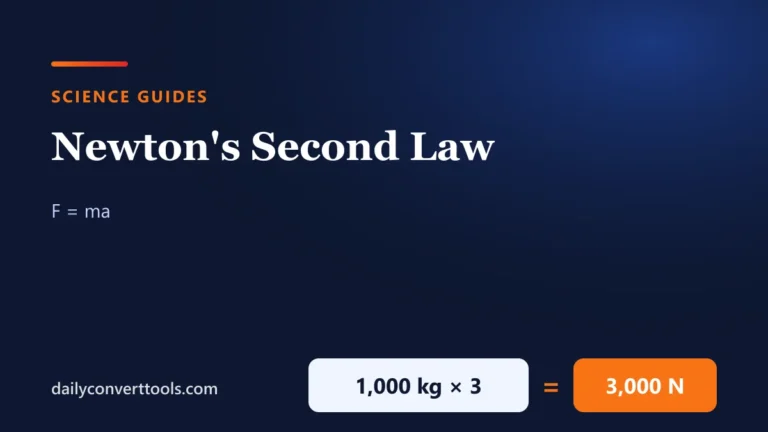
For the force needed to change motion, see Newton’s second law.
Frequently asked questions
What is the kinetic energy formula?
KE = ½mv².
What unit is kinetic energy measured in?
Joules (J).
What happens to kinetic energy if speed doubles?
It becomes four times larger.
What is the potential energy formula?
PE = mgh for gravitational potential energy.