Ohm’s Law: V = IR Explained, With Formulas and Examples
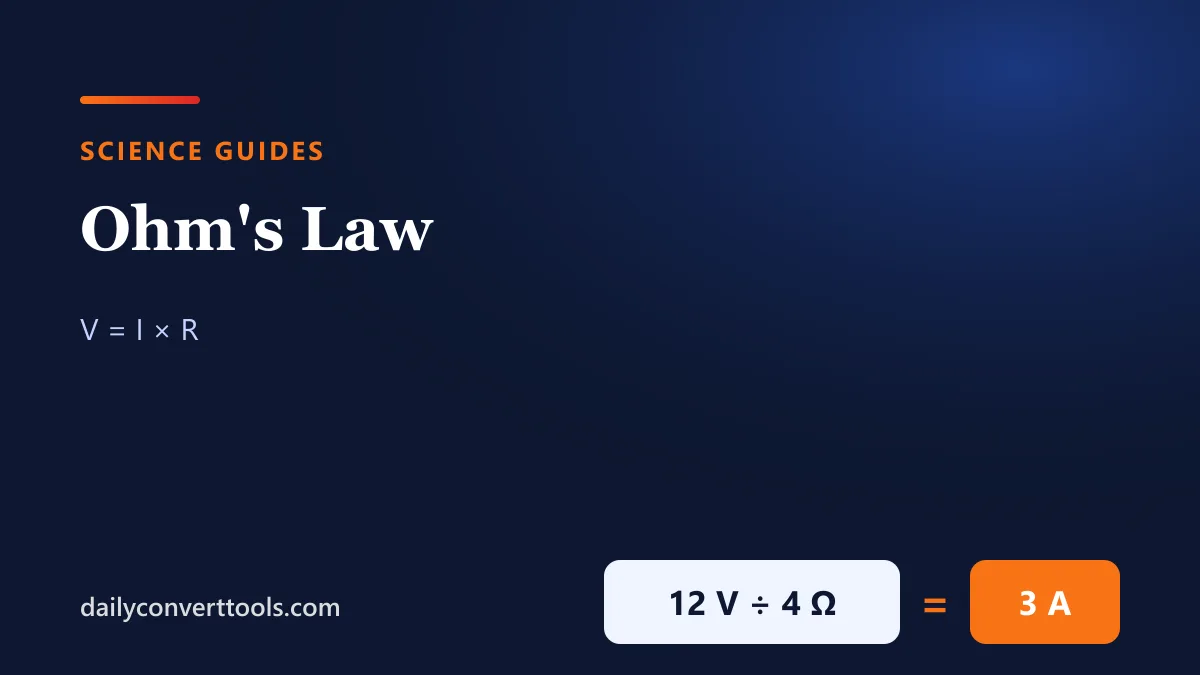
Ohm’s law is the basic rule of electrical circuits. It links three quantities: voltage (V, in volts), current (I, in amps) and resistance (R, in ohms, Ω).
Quick answer
| To find | Formula | Example |
|---|---|---|
| Voltage | V = I × R | 2 A × 6 Ω = 12 V |
| Current | I = V ÷ R | 12 V ÷ 4 Ω = 3 A |
| Resistance | R = V ÷ I | 9 V ÷ 0.5 A = 18 Ω |
The Ohm’s law triangle
Draw a triangle with V at the top and I and R side by side at the bottom. Cover the quantity you want: what’s left shows the formula. Cover V and you see I × R; cover I and you see V over R; cover R and you see V over I.
Adding power
Power (P, in watts) combines with Ohm’s law into a family of formulas:
| Formula | Example |
|---|---|
| P = V × I | 12 V × 2 A = 24 W |
| P = I² × R | 2² × 6 = 24 W |
| P = V² ÷ R | 12² ÷ 6 = 24 W |
For household appliances, see watts to amps and how to calculate electricity cost.
Worked examples
- LED resistor: a 5 V supply, an LED that drops 2 V, and a target current of 20 mA (0.02 A). The resistor drops the other 3 V, so R = 3 ÷ 0.02 = 150 Ω.
- Heater element: a 1,500 W heater on 120 V draws I = 1,500 ÷ 120 = 12.5 A, so its resistance is R = 120 ÷ 12.5 = 9.6 Ω.
- Car bulb: a 12 V, 5 W bulb draws 5 ÷ 12 ≈ 0.42 A.
Series and parallel resistors
- Series: resistances add. 100 Ω + 220 Ω = 320 Ω.
- Parallel: 1/R = 1/R₁ + 1/R₂. Two 100 Ω resistors in parallel give 50 Ω.
- Two in parallel shortcut: R = (R₁ × R₂) ÷ (R₁ + R₂).
Limits of Ohm’s law
Ohm’s law describes “ohmic” materials like metal wires and resistors, whose resistance stays steady. Components like LEDs, diodes and filament bulbs (whose resistance rises as they heat up) don’t follow it exactly. For mains electricity, always follow safety guidance and use a qualified electrician.
Frequently asked questions
What is Ohm’s law?
Voltage equals current times resistance: V = IR.
How do I calculate current?
Divide voltage by resistance: I = V ÷ R.
What is the unit of resistance?
The ohm, written Ω.
How does power relate to Ohm’s law?
P = V × I, which also gives P = I²R and P = V²/R.