Systems of Equations: Solve by Substitution, Elimination and Graphing
A system of equations is two or more equations that share the same unknowns. Solving it means finding values that make every equation true at once. For two straight lines, that’s the point where they cross.
Quick answer
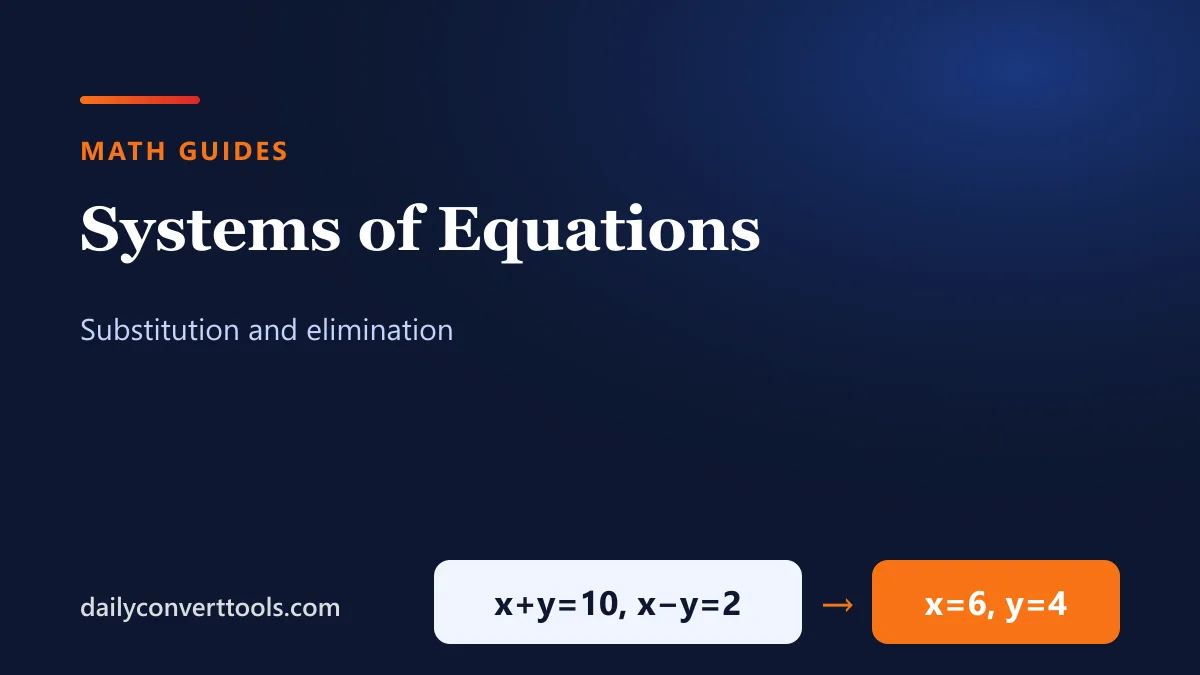
For x + y = 10 and x − y = 2, the solution is x = 6, y = 4. Check: 6 + 4 = 10 and 6 − 4 = 2.
Method 1: substitution
Solve y = 2x − 1 and 3x + y = 14.
- First, one equation already gives y: y = 2x − 1.
- Then substitute into the other: 3x + (2x − 1) = 14, so 5x = 15 and x = 3.
- Finally, back-substitute: y = 2(3) − 1 = 5. Solution: (3, 5).
Method 2: elimination
Solve 2x + 3y = 13 and 4x − 3y = 5.
- First, notice the y terms cancel if you add the equations: 6x = 18, so x = 3.
- Then substitute: 2(3) + 3y = 13, so 3y = 7 and y = 7/3.
- If nothing cancels at first, multiply one or both equations so a variable matches, then add or subtract.
Method 3: graphing
Rewrite each equation in slope-intercept form and plot both lines. The crossing point is the solution. Graphing is great for seeing what’s happening but less precise for fractional answers.
How many solutions?
| Lines | Number of solutions | What you see when solving |
|---|---|---|
| Cross once | One | A single x and y |
| Parallel (same slope, different intercept) | None | A false statement like 0 = 5 |
| The same line | Infinitely many | A true statement like 0 = 0 |
Word problem
Adult tickets cost $12 and child tickets $8. A group buys 9 tickets for $92. How many of each?
- First, set up: a + c = 9 and 12a + 8c = 92.
- Then substitute a = 9 − c: 12(9 − c) + 8c = 92 → 108 − 4c = 92 → c = 4.
- Finally, a = 5: 5 adult and 4 child tickets. Check: 5 × 12 + 4 × 8 = 92.
Which method should I use?
- Substitution: when one variable is already alone, or has a coefficient of 1.
- Elimination: when coefficients match or are easy to match.
- Graphing: to visualise, or to check your answer.
Frequently asked questions
What is a system of equations?
Two or more equations with the same unknowns, solved together.
How do I solve a system by substitution?
Solve one equation for a variable, substitute into the other, then back-substitute.
What does no solution mean?
The lines are parallel and never meet.
Can a system have infinitely many solutions?
Yes, when both equations describe the same line.