Logarithms Explained: Rules, Examples and Natural Log (ln)
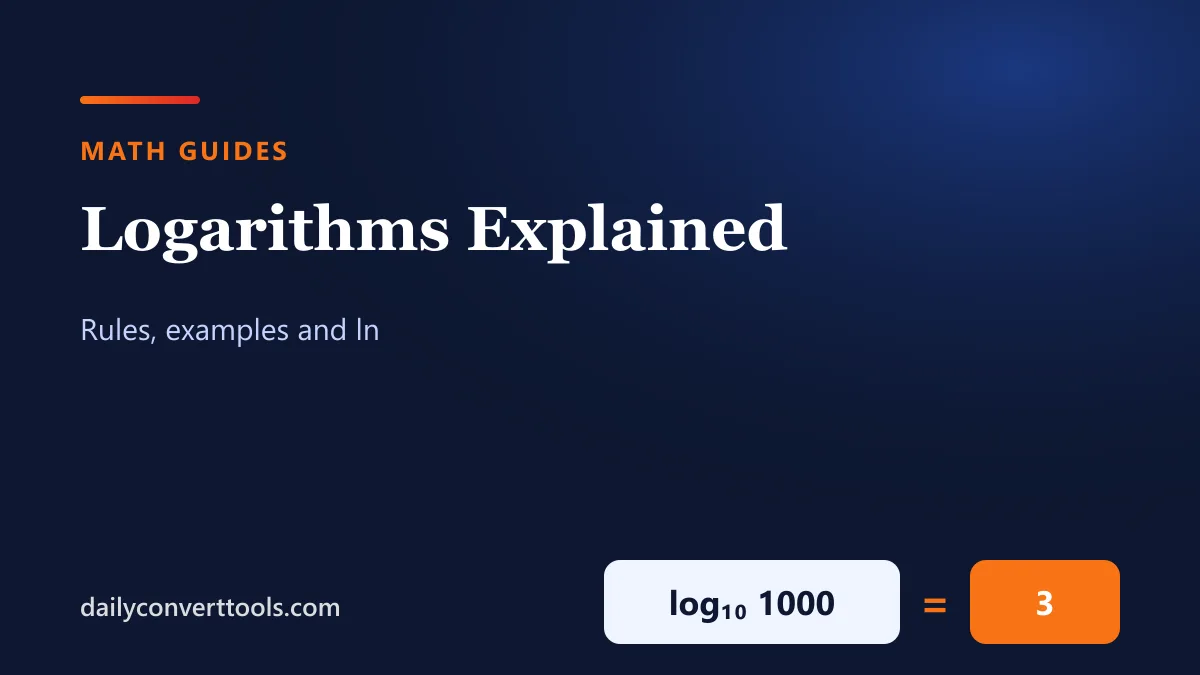
A logarithm is the reverse of an exponent. It answers the question: what power do I raise the base to, to get this number? Since 10³ = 1,000, log₁₀ 1,000 = 3.
Quick answer
- logb(x) = y means by = x.
- log₁₀ 100 = 2; log₂ 8 = 3; log₅ 25 = 2.
- ln is the natural log, with base e ≈ 2.71828. log on its own usually means base 10.
The log rules
| Rule | Formula | Example |
|---|---|---|
| Product | log(xy) = log x + log y | log 20 = log 2 + log 10 |
| Quotient | log(x/y) = log x − log y | log 5 = log 10 − log 2 |
| Power | log(xn) = n log x | log 1000 = 3 log 10 = 3 |
| Log of 1 | logb 1 = 0 | ln 1 = 0 |
| Log of the base | logb b = 1 | log 10 = 1 |
| Change of base | logb x = log x ÷ log b | log₂ 10 = 1 ÷ 0.3010 ≈ 3.3219 |
Common values
| x | log₁₀ x | ln x | log₂ x |
|---|---|---|---|
| 1 | 0.0000 | 0.0000 | 0.0000 |
| 2 | 0.3010 | 0.6931 | 1.0000 |
| 5 | 0.6990 | 1.6094 | 2.3219 |
| 10 | 1.0000 | 2.3026 | 3.3219 |
| 50 | 1.6990 | 3.9120 | 5.6439 |
| 100 | 2.0000 | 4.6052 | 6.6439 |
| 1000 | 3.0000 | 6.9078 | 9.9658 |
The natural log (ln)
The natural log uses base e, the number that appears in continuous growth. ln(e) = 1, and ln(ex) = x. It’s used in science, finance and statistics, for example to find growth time: money growing continuously at 5% doubles in ln 2 ÷ 0.05 ≈ 13.9 years. Compare the Rule of 72.
Solving equations with logs
To solve 3x = 50, take logs of both sides: x log 3 = log 50, so x = log 50 ÷ log 3 ≈ 3.561.
Where logs appear
- pH: pH = −log₁₀ of the hydrogen ion concentration; each pH step is a factor of 10.
- Decibels and earthquake magnitudes: log scales compress huge ranges into small numbers.
- Computing: log₂ tells you how many bits you need; see binary to decimal.
On a calculator or spreadsheet
Use LOG for base 10 and LN for base e. In Excel and Google Sheets: =LOG10(100), =LN(10), or =LOG(8,2) for any base.
For the reverse operation, see exponents.
Frequently asked questions
What is a logarithm?
The power you raise a base to in order to get a number: log₁₀ 1000 = 3.
What is ln?
The natural logarithm, with base e ≈ 2.718.
What is log 1?
0, in any base.
How do I change the base of a log?
Use log_b x = log x ÷ log b.