Prime Factorization: How to Find It (Factor Trees and Examples)
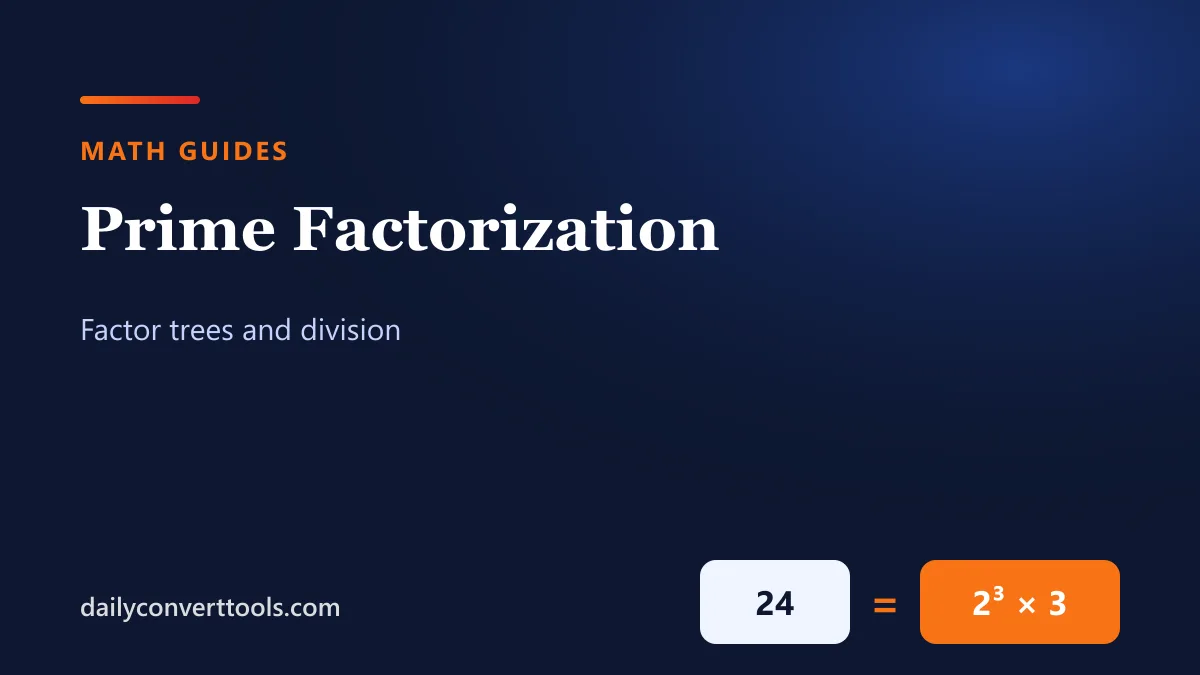
Every whole number greater than 1 is either prime or can be written as a product of primes in exactly one way. Finding that product is called prime factorization, and it’s the key to simplifying fractions, finding the GCF and LCM, and working with roots.
Quick answer
- 24 = 2 × 2 × 2 × 3 = 2³ × 3
- Primes are numbers with exactly two factors, 1 and themselves: 2, 3, 5, 7, 11, 13, 17, 19, 23, 29…
- 1 is not a prime number.
Method 1: factor tree
- First, split the number into any two factors: 60 = 6 × 10.
- Then keep splitting any factor that isn’t prime: 6 = 2 × 3 and 10 = 2 × 5.
- Finally, collect the primes at the ends of the branches: 60 = 2 × 2 × 3 × 5 = 2² × 3 × 5.
Method 2: repeated division
Divide by the smallest prime that goes in, and repeat. For 180: ÷2 = 90, ÷2 = 45, ÷3 = 15, ÷3 = 5, ÷5 = 1. So 180 = 2² × 3² × 5.
Examples
| Number | Prime factorization |
|---|---|
| 12 | 22 × 3 |
| 24 | 23 × 3 |
| 36 | 22 × 32 |
| 48 | 24 × 3 |
| 60 | 22 × 3 × 5 |
| 72 | 23 × 32 |
| 84 | 22 × 3 × 7 |
| 90 | 2 × 32 × 5 |
| 100 | 22 × 52 |
| 120 | 23 × 3 × 5 |
| 144 | 24 × 32 |
| 210 | 2 × 3 × 5 × 7 |
| 360 | 23 × 32 × 5 |
| 1000 | 23 × 53 |
All the factors of 24
The factors of 24 are 1, 2, 3, 4, 6, 8, 12, 24: 8 in total. As factor pairs: 1 × 24, 2 × 12, 3 × 8 and 4 × 6. From the prime factorization 2³ × 3, you can count them: (3 + 1) × (1 + 1) = 8.
| Number | Factors |
|---|---|
| 12 | 1, 2, 3, 4, 6, 12 |
| 18 | 1, 2, 3, 6, 9, 18 |
| 24 | 1, 2, 3, 4, 6, 8, 12, 24 |
| 30 | 1, 2, 3, 5, 6, 10, 15, 30 |
| 36 | 1, 2, 3, 4, 6, 9, 12, 18, 36 |
| 48 | 1, 2, 3, 4, 6, 8, 12, 16, 24, 48 |
| 60 | 1, 2, 3, 4, 5, 6, 10, 12, 15, 20, 30, 60 |
| 100 | 1, 2, 4, 5, 10, 20, 25, 50, 100 |
Is it prime?
To test a number, try dividing by primes up to its square root. To check 97: √97 ≈ 9.8, and 97 isn’t divisible by 2, 3, 5 or 7, so 97 is prime.
Why it’s useful
- GCF and LCM: see greatest common factor and least common multiple.
- Simplifying roots: √72 = √(2³ × 3²) = 6√2; see square roots.
- Simplifying fractions: see how to add and simplify fractions.
Frequently asked questions
What is prime factorization?
Writing a number as a product of prime numbers, like 24 = 2³ × 3.
What are the factors of 24?
1, 2, 3, 4, 6, 8, 12, 24.
Is 1 a prime number?
No. A prime has exactly two factors, and 1 has only one.
What is the prime factorization of 100?
2² × 5².