Completing the Square: Step-by-Step Method With Examples
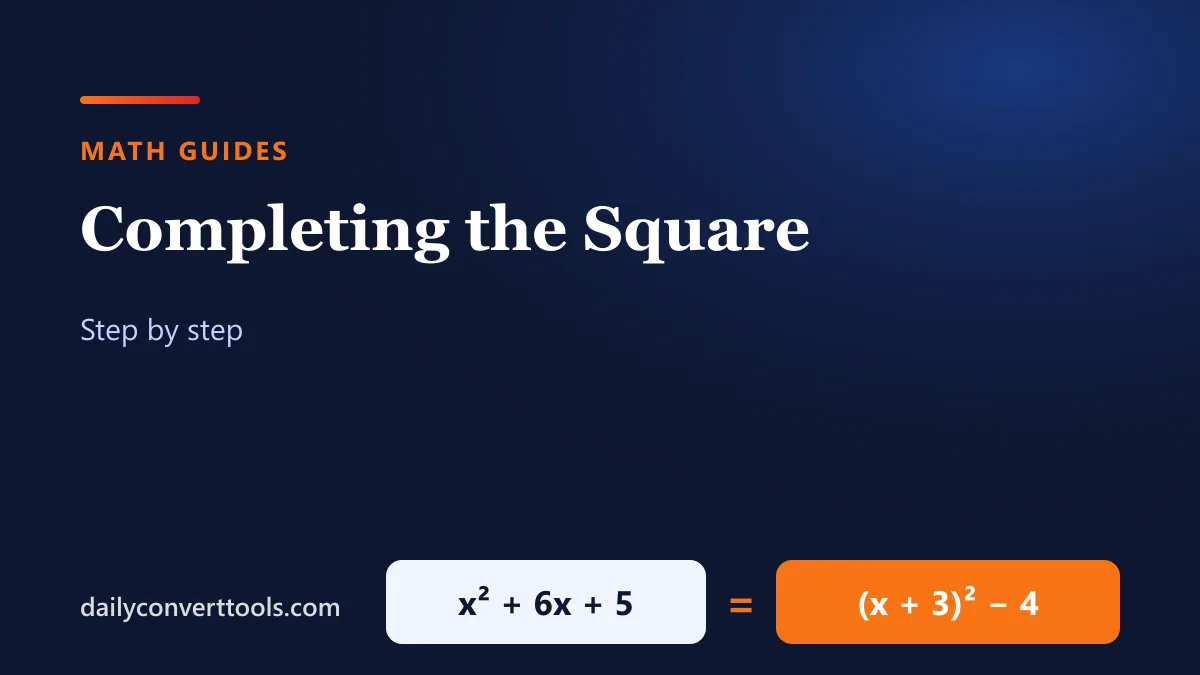
Completing the square turns a quadratic like x² + 6x + 5 into a perfect square plus a number, (x + 3)² − 4. It’s used to solve quadratic equations, find the vertex of a parabola, and derive the quadratic formula itself.
Quick answer
- Take the coefficient of x and halve it: for x² + 6x, half of 6 is 3.
- Square that number: 3² = 9.
- Add and subtract it: x² + 6x + 9 − 9 = (x + 3)² − 9.
- Combine with the constant: x² + 6x + 5 = (x + 3)² − 4.
Example 1: solving an equation
Solve x² + 8x − 9 = 0.
- First, move the constant: x² + 8x = 9.
- Then add (8 ÷ 2)² = 16 to both sides: x² + 8x + 16 = 25.
- Next, write the square: (x + 4)² = 25.
- Then take square roots: x + 4 = ±5.
- Finally, x = 1 or x = −9.
Example 2: when a isn’t 1
Solve 2x² − 12x + 10 = 0.
- First, divide everything by 2: x² − 6x + 5 = 0.
- Then move the constant: x² − 6x = −5.
- Next, add (−6 ÷ 2)² = 9: (x − 3)² = 4.
- Finally, x − 3 = ±2, so x = 5 or x = 1.
Finding the vertex
Completing the square gives vertex form directly. For y = x² − 4x + 7: x² − 4x + 4 − 4 + 7 = (x − 2)² + 3, so the vertex is (2, 3) and the minimum value is 3.
Examples
| Expression | Half b, squared | Completed square |
|---|---|---|
| x² + 2x + 3 | 1 | (x + 1)² + 2 |
| x² + 10x + 20 | 25 | (x + 5)² − 5 |
| x² − 8x + 10 | 16 | (x − 4)² − 6 |
| x² + 5x | 6.25 | (x + 2.5)² − 6.25 |
| x² − 3x + 1 | 2.25 | (x − 1.5)² − 1.25 |
Where the quadratic formula comes from
Completing the square on ax² + bx + c = 0 in general gives (x + b/2a)² = (b² − 4ac) ÷ 4a², which leads straight to the quadratic formula.
Common mistakes
- Forgetting to divide by a first when it isn’t 1.
- Adding the square to one side of an equation only.
- Forgetting the ± when taking the square root.
Frequently asked questions
What does completing the square mean?
Rewriting a quadratic as a perfect square plus a constant.
How do I complete the square?
Halve the x coefficient, square it, add and subtract it, then factor the perfect square.
Why complete the square?
To solve quadratics, find the vertex, or derive the quadratic formula.
What if the leading coefficient isn’t 1?
Divide through by it first.