Vertex Form of a Quadratic: y = a(x − h)² + k Explained
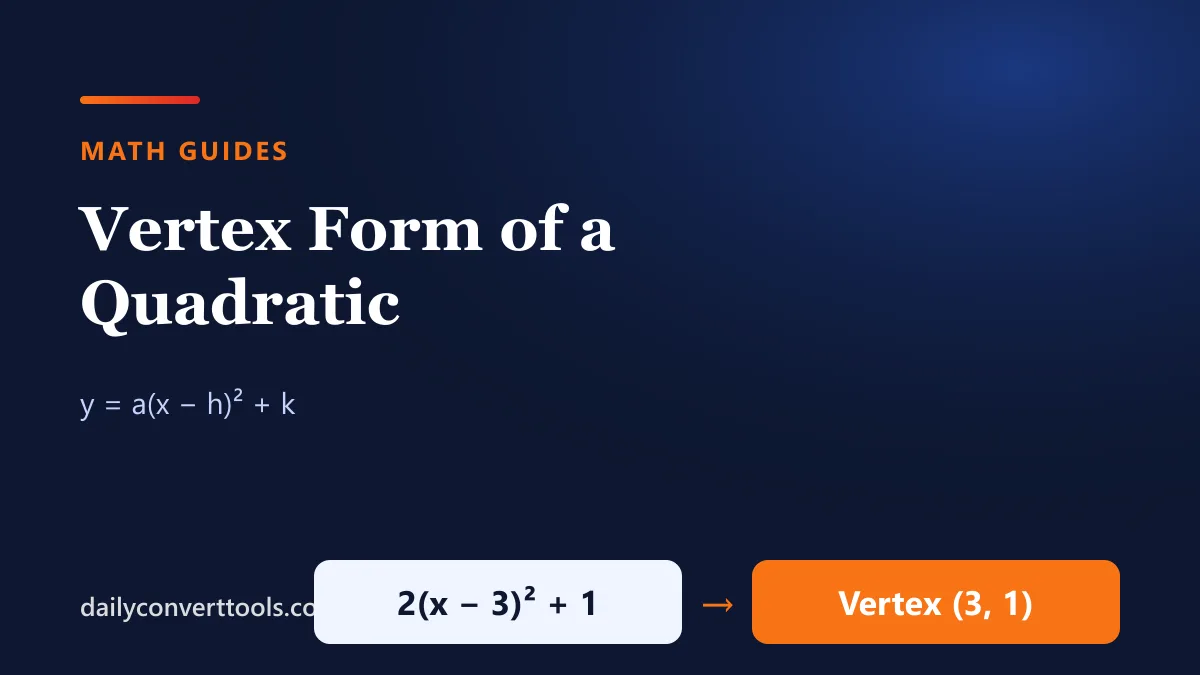
Vertex form is a way of writing a quadratic equation that shows the vertex (the turning point) of its parabola at a glance.
Quick answer
y = a(x − h)² + k
- The vertex is (h, k). Watch the sign: y = 2(x − 3)² + 1 has vertex (3, 1), but y = 2(x + 3)² + 1 has vertex (−3, 1).
- If a > 0 the parabola opens upward (the vertex is a minimum); if a < 0 it opens downward (a maximum).
- The axis of symmetry is the vertical line x = h.
Reading vertex form
| Equation | Vertex | Opens | Axis of symmetry |
|---|---|---|---|
| y = (x − 2)² + 5 | (2, 5) | Up | x = 2 |
| y = −3(x + 1)² + 4 | (−1, 4) | Down | x = −1 |
| y = ½(x − 4)² − 6 | (4, −6) | Up, wider | x = 4 |
| y = x² − 9 | (0, −9) | Up | x = 0 |
Converting from standard form (y = ax² + bx + c)
Method 1: the vertex formula. h = −b ÷ 2a, then k = y at x = h. For y = 2x² − 12x + 19: h = 12 ÷ 4 = 3, and k = 2(9) − 36 + 19 = 1. So y = 2(x − 3)² + 1.
Method 2: completing the square. See completing the square for the step-by-step method.
Graphing from vertex form
- First, plot the vertex (h, k).
- Then pick x-values either side of h and work out y. For y = 2(x − 3)² + 1: at x = 2 and x = 4, y = 3.
- Finally, draw a smooth U-shape through the points, symmetric about x = h.
Finding the equation from a vertex and a point
A parabola has vertex (1, −2) and passes through (3, 6). Substitute: 6 = a(3 − 1)² − 2, so 8 = 4a and a = 2. The equation is y = 2(x − 1)² − 2.
Why vertex form is useful
- Maximum and minimum problems: the vertex is the highest or lowest point, such as a ball’s peak height.
- Transformations: h shifts the graph left or right, k shifts it up or down, and a stretches or flips it.
- For solving quadratics, the quadratic formula works from standard form.
Frequently asked questions
What is vertex form?
y = a(x − h)² + k, where (h, k) is the vertex.
How do I find the vertex from standard form?
Use h = −b ÷ 2a, then substitute h to find k.
What does a tell you?
Its sign shows whether the parabola opens up or down; its size shows how narrow or wide it is.
What is the vertex of y = (x + 4)² − 3?
(−4, −3).