Absolute Value: What It Means and How to Solve Equations
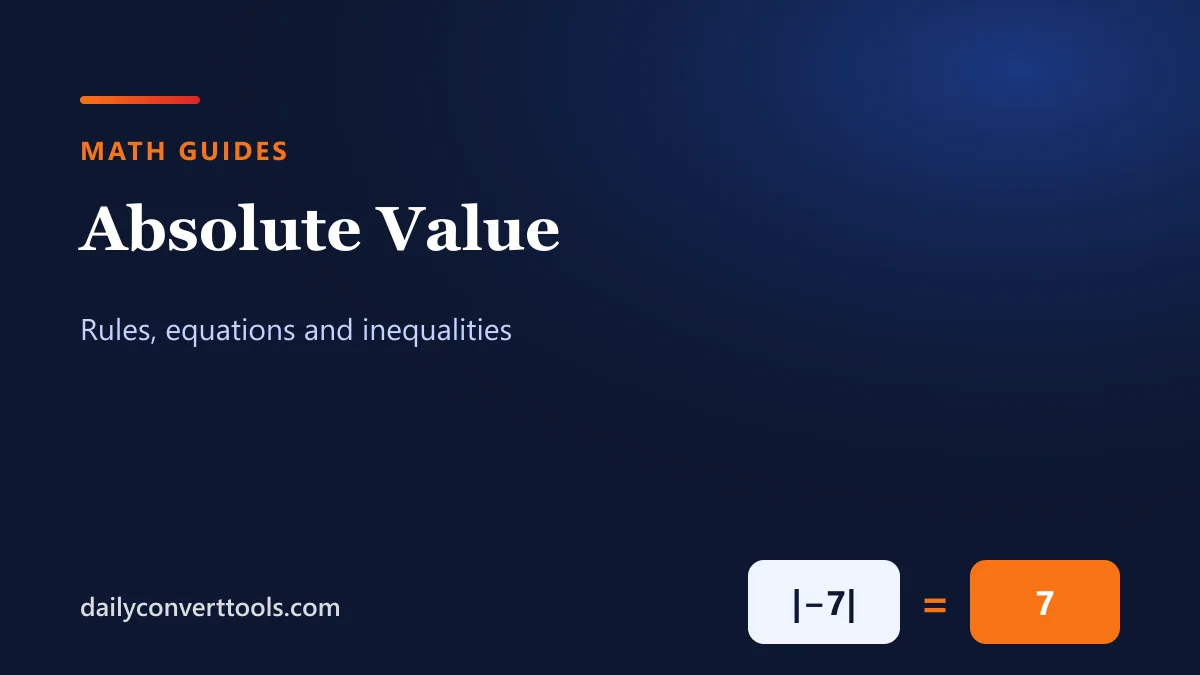
The absolute value of a number is its distance from zero on the number line, ignoring direction. It’s written with vertical bars: |−7| = 7 and |7| = 7.
Quick answer
- Absolute value is never negative.
- |positive number| = the number itself: |12| = 12.
- |negative number| = the number without its minus sign: |−4.5| = 4.5.
- |0| = 0.
Evaluating expressions
Work out what’s inside the bars first, then take the absolute value.
| Expression | Inside first | Answer |
|---|---|---|
| |3 − 8| | |−5| | 5 |
| |−2| + |5| | 2 + 5 | 7 |
| −|6| | −(6) | −6 |
| |4 × (−3)| | |−12| | 12 |
| |−10| ÷ |−2| | 10 ÷ 2 | 5 |
Note that −|6| = −6: the minus sign is outside the bars, so it applies after.
Solving absolute value equations
|x − 3| = 5 means x − 3 is 5 units from zero, so it’s either 5 or −5:
- First, x − 3 = 5, so x = 8.
- Then x − 3 = −5, so x = −2.
- So x = 8 or −2. Check: |8 − 3| = 5 and |−2 − 3| = 5.
If an absolute value is set equal to a negative number, such as |x| = −3, there’s no solution.
Absolute value inequalities
- |x| < 4 means x is within 4 of zero: −4 < x < 4.
- |x| > 4 means x is more than 4 away: x < −4 or x > 4.
- |x − 10| ≤ 2 means 8 ≤ x ≤ 12.
Where it’s used
- Distances: the distance between a and b on a number line is |a − b|.
- Errors: percent error uses |measured − true|; see the percent error formula.
- Tolerances: a part 50 mm ± 0.1 mm means |length − 50| ≤ 0.1.
- Spreadsheets:
=ABS(A1)returns the absolute value.
Frequently asked questions
What is absolute value?
A number’s distance from zero, which is never negative.
What is the absolute value of −15?
15.
Can absolute value be negative?
No, but an expression like −|x| can be.
How many solutions does |x| = 5 have?
Two: 5 and −5.