Surface Area of a Cylinder: Formula and Worked Examples
The surface area of a cylinder is the total area of its outside: two circular ends plus the curved side. You’ll need it for labels, paint, insulation and sheet metal.
Quick answer
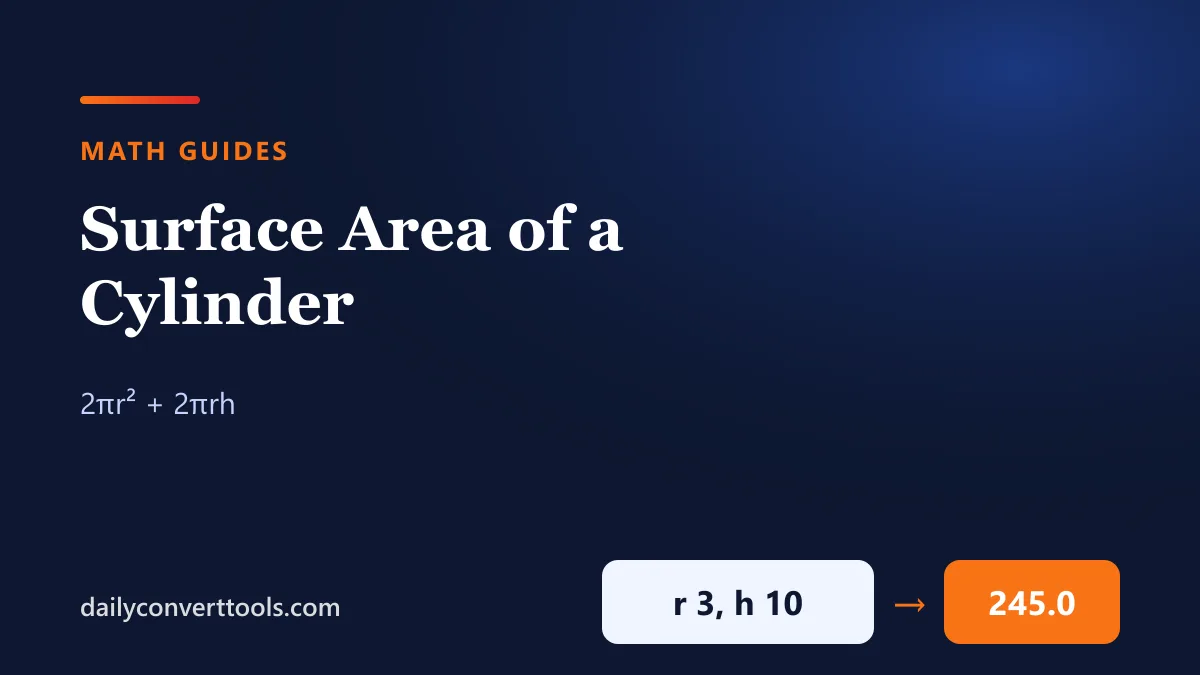
Surface area = 2πr² + 2πrh (or 2πr(r + h))
Example: r = 3 cm, h = 10 cm. 2π × 9 + 2π × 30 = 78π ≈ 245.0 cm².
Where the formula comes from
- The two ends are circles, each πr², so together 2πr².
- The curved side unrolls into a rectangle. Its width is the circle’s circumference (2πr) and its height is h, so its area is 2πrh.
Examples
| Object | Radius | Height | Surface area |
|---|---|---|---|
| Soda can | 3.3 cm | 12.2 cm | 321 cm² |
| Paper towel tube (open) | 2.2 cm | 28 cm | 387 cm² (side only) |
| Water heater (closed) | 0.25 m | 1.5 m | 2.75 m² |
| Round column (side only) | 0.15 m | 3 m | 2.83 m² |
Open cylinders and side only
- Open at one end (a cup or bucket): πr² + 2πrh.
- Open at both ends (a pipe or tube): 2πrh only.
- Label for a can: just the side, 2πrh, plus a little overlap for glue.
Paint example
To paint a round column 0.15 m in radius and 3 m tall, you need the side area: 2π × 0.15 × 3 ≈ 2.83 m². Check your paint tin’s coverage per litre and allow for two coats.
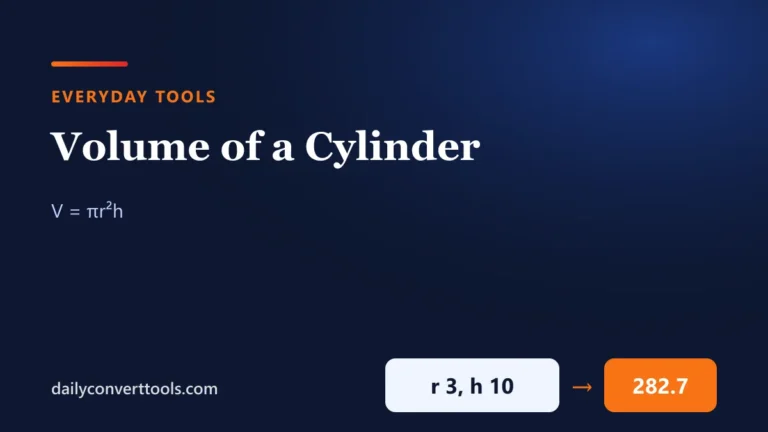
For how much a cylinder holds, see volume of a cylinder; for the ends, see area of a circle.
Frequently asked questions
What is the surface area of a cylinder?
2πr² + 2πrh.
What is the lateral surface area?
Just the curved side: 2πrh.
How do I find the surface area of an open cylinder?
Leave out one or both circular ends (πr² each).
What units is surface area in?
Square units, such as cm² or sq ft.