Pythagorean Theorem: Formula, Examples and How to Use It
The Pythagorean theorem links the three sides of a right triangle (one with a 90° angle). It’s one of the most useful formulas in maths, used in building, navigation, design and everyday measuring.
Quick answer
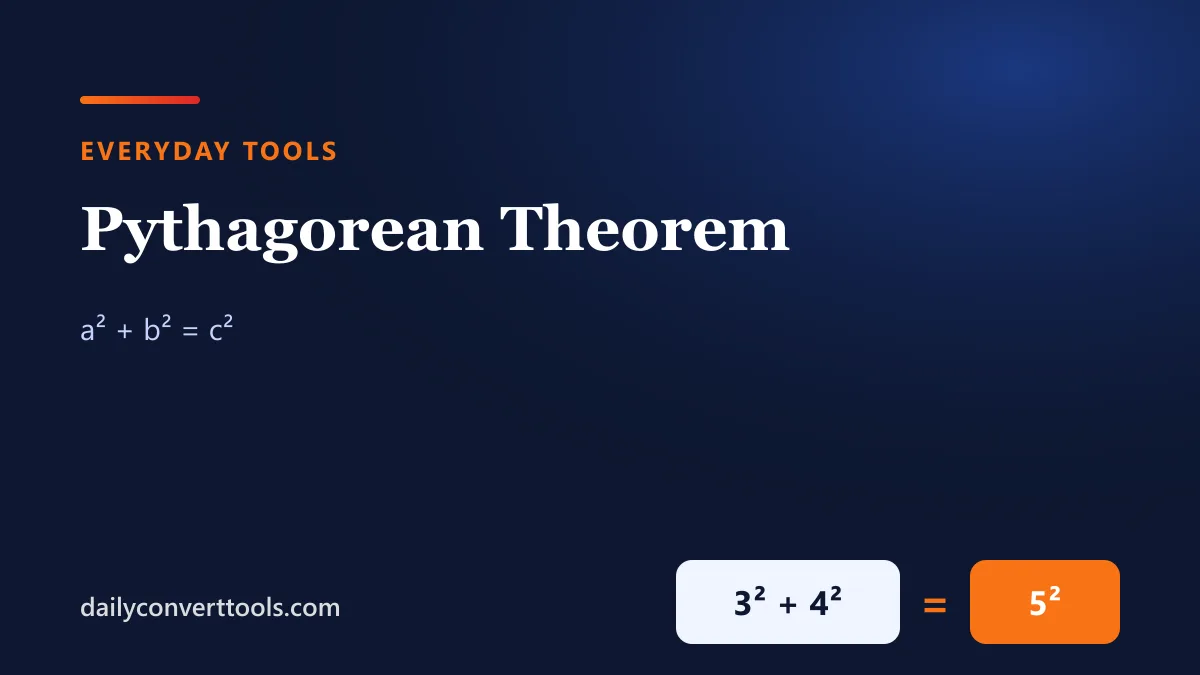
a² + b² = c², where a and b are the two shorter sides (legs) and c is the longest side (the hypotenuse, opposite the right angle).
- Find the hypotenuse: c = √(a² + b²)
- Find a leg: a = √(c² − b²)
- Example: legs 3 and 4 give c = √(9 + 16) = √25 = 5.
Finding the hypotenuse
- First, square both legs: 6² = 36 and 8² = 64.
- Then add them: 36 + 64 = 100.
- Finally, take the square root: √100 = 10.
Finding a missing leg
- First, square the hypotenuse and the known leg: 13² = 169 and 5² = 25.
- Then subtract: 169 − 25 = 144.
- Finally, take the square root: √144 = 12.
Not every answer is a whole number: legs of 5 and 7 give c = √74 ≈ 8.60. For help with roots, see how to find a square root.
Pythagorean triples
These whole-number sets fit the formula exactly, and multiples of them work too (6-8-10, 9-12-15).
| a | b | c | Check |
|---|---|---|---|
| 3 | 4 | 5 | 9 + 16 = 25 |
| 5 | 12 | 13 | 25 + 144 = 169 |
| 8 | 15 | 17 | 64 + 225 = 289 |
| 7 | 24 | 25 | 49 + 576 = 625 |
| 20 | 21 | 29 | 400 + 441 = 841 |
| 9 | 40 | 41 | 81 + 1600 = 1681 |
Real-world uses
- Squaring a corner: builders mark 3 ft on one side and 4 ft on the other; if the diagonal is exactly 5 ft, the corner is square (the 3-4-5 rule).
- Ladders: a 13 ft ladder with its foot 5 ft from a wall reaches 12 ft up.
- Screen sizes: a 16:9 screen 48 in wide and 27 in tall has a diagonal of √(48² + 27²) ≈ 55.1 in.
- Distance on a map: 3 km east and 4 km north is 5 km in a straight line.
Common mistakes
- Using it on a triangle without a right angle; it only works for right triangles.
- Mixing up which side is c: the hypotenuse is always the longest side, opposite the right angle.
- Forgetting the square root at the end: c² = 25 means c = 5.
For triangle area, see area of a triangle.
Frequently asked questions
What is the Pythagorean theorem?
In a right triangle, a² + b² = c², where c is the hypotenuse.
How do I find the hypotenuse?
Square the two legs, add them, and take the square root.
Does it work for any triangle?
No, only right triangles.
What is a Pythagorean triple?
Three whole numbers that fit a² + b² = c², such as 3, 4, 5.