How to Calculate a Mortgage Payment (Principal, Interest, Taxes, PMI)
A mortgage calculator tells you what a home will cost each month. The heart of it is the same formula used for any fixed-rate loan, but a real mortgage payment usually includes more than the loan itself: property tax, homeowners insurance and sometimes mortgage insurance.
Quick answer
Monthly principal and interest: M = P × r × (1 + r)n ÷ ((1 + r)n − 1), where P is the loan amount, r is the annual rate ÷ 12, and n is the number of monthly payments.
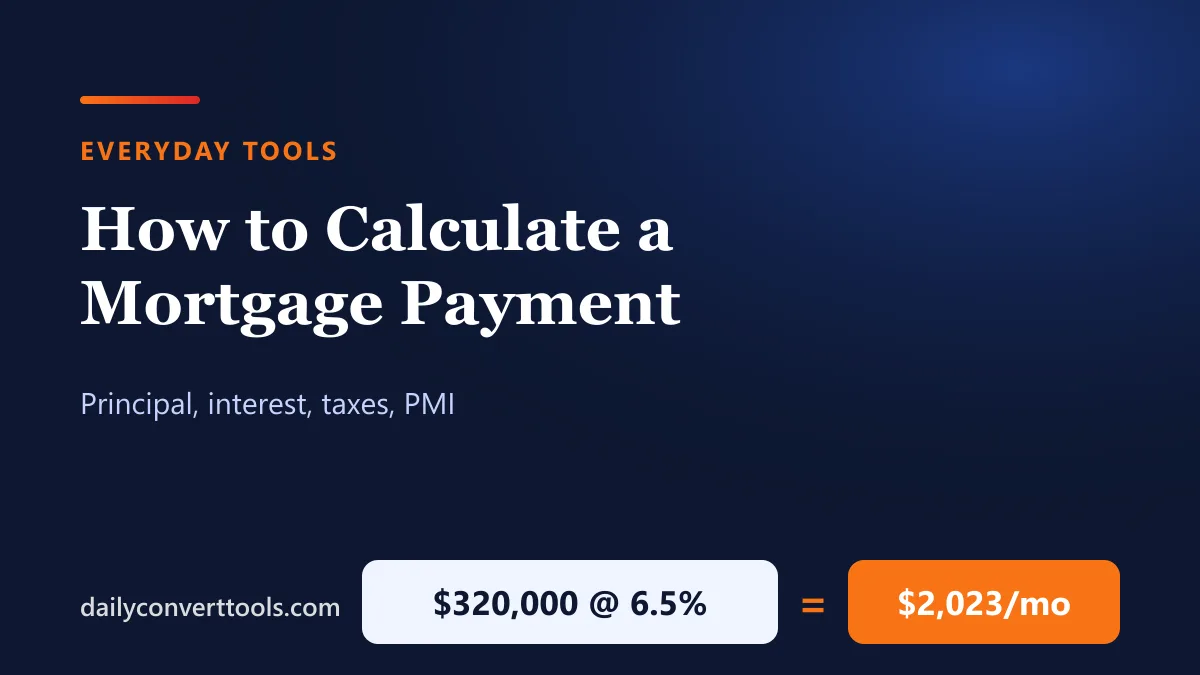
- For example, a $400,000 home with 20% down needs a $320,000 loan.
- Then, at 6.5% for 30 years, principal and interest is $2,022.62 a month.
- Finally, add property tax and insurance to get the full payment (often called PITI).
The four parts of a mortgage payment (PITI)
| Part | What it is | Example (monthly) |
|---|---|---|
| Principal | Pays down the loan | Part of $2,022.62 |
| Interest | The lender’s charge on the balance | Part of $2,022.62 |
| Taxes | Property tax, which lenders often collect into escrow | $366.67 (1.1% a year, example) |
| Insurance | Homeowners insurance | $150.00 ($1,800 a year, example) |
As a result, the total in this example is about $2,539.28 a month. However, tax rates and insurance costs vary a lot by location, so use real quotes for your area.
Private mortgage insurance (PMI)
According to the Consumer Financial Protection Bureau, your lender might require you to buy PMI if you take out a conventional loan with a down payment of less than 20 percent of the purchase price. Note that it protects the lender, not you, and it adds to the monthly cost until the lender removes it. Government-backed loans have their own mortgage insurance rules.
15-year vs 30-year
| Term | Monthly principal & interest | Total interest |
|---|---|---|
| 30 years | $2,022.62 | $408,142.36 |
| 15 years | $2,787.54 | $181,757.84 |
The 15-year loan costs more each month but saves $226,384.52 in interest on this $320,000 loan.
How the balance falls over 30 years
| Year | Interest paid that year | Principal paid that year | Balance at year end |
|---|---|---|---|
| 1 | $20,694.69 | $3,576.72 | $316,423.28 |
| 5 | $19,635.91 | $4,635.50 | $299,555.13 |
| 10 | $17,861.36 | $6,410.06 | $271,283.60 |
| 15 | $15,407.48 | $8,863.94 | $232,189.25 |
| 20 | $12,014.21 | $12,257.20 | $178,128.90 |
| 25 | $7,321.94 | $16,949.47 | $103,373.32 |
| 30 | $833.39 | $23,438.03 | $0.00 |
In the early years, most of each payment is interest; by contrast, in the final years it’s mostly principal. Therefore, extra payments early on save the most.
What changes your payment
- Rate: on this loan, each 0.5 percentage point changes the payment by about $106.35 a month.
- Down payment: a bigger down payment means a smaller loan, and 20% or more avoids PMI on a conventional loan.
- Term: shorter terms raise the payment but cut total interest.
- Points and fees: compare loans using the APR and the Loan Estimate lenders must give you.
For the general loan formula and a worked car-loan example, see how to calculate loan payments.
Frequently asked questions
How do I calculate my mortgage payment?
Use the loan payment formula for principal and interest, then add monthly property tax, insurance and any PMI.
What is the payment on a $320,000 mortgage at 6.5%?
$2,022.62 a month for principal and interest over 30 years.
What does PITI stand for?
Principal, interest, taxes and insurance.
When is PMI required?
Often on conventional loans with less than 20% down, according to the CFPB.