Volume of a Cylinder: Formula, Examples and Unit Conversions
A cylinder is a circle stretched into a tube: cans, tanks, pipes, candles and round planters are all cylinders. Its volume is the area of the circular end times the height.
Quick answer
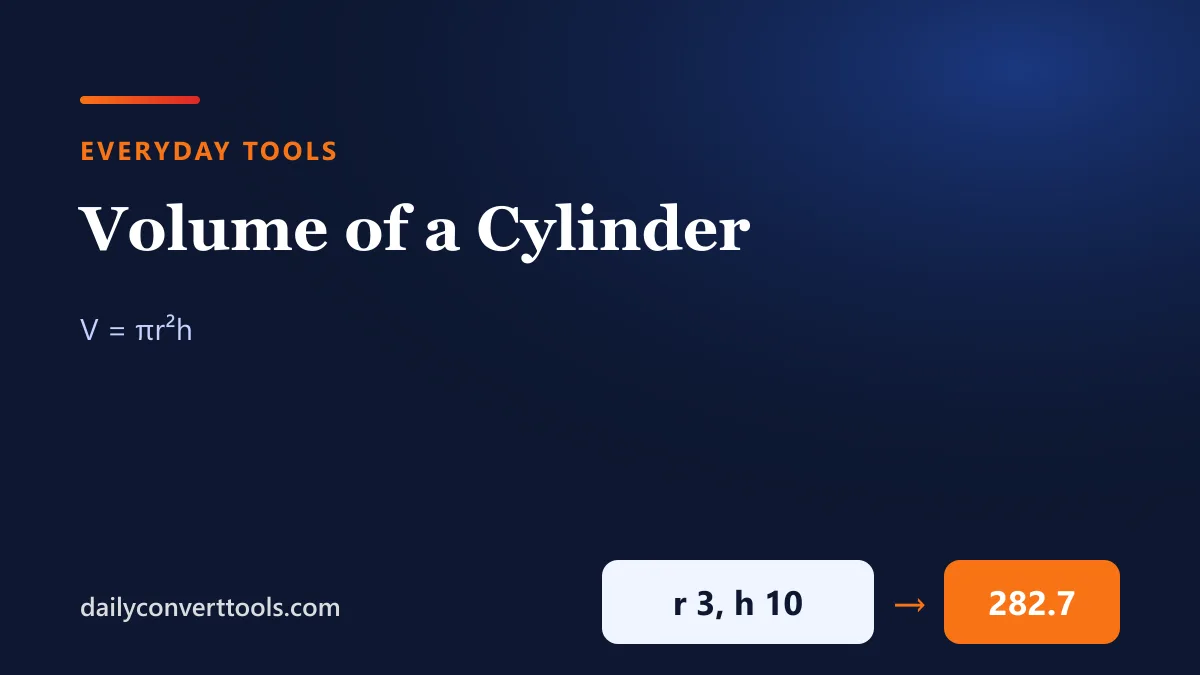
V = π × r² × h, where r is the radius and h is the height (or length).
Example: radius 3 cm, height 10 cm. V = π × 9 × 10 ≈ 282.7 cm³ (282.7 ml).
Step by step
- First, measure the diameter and halve it to get the radius.
- Then square the radius and multiply by π to get the area of the end.
- Finally, multiply by the height. Keep all measurements in the same unit.
Worked examples
| Object | Radius | Height | Volume |
|---|---|---|---|
| Soda can | 3.3 cm | 12.2 cm | 417 cm³ (about 417 ml) |
| Round planter | 1 ft | 1.5 ft | 4.71 cu ft (35.3 US gal) |
| Water tank | 0.6 m | 1.5 m | 1.696 m³ (1,696 L) |
| Pipe, 2 in inside diameter | 1 in | 10 ft (120 in) | 377.0 cu in (1.63 US gal) |
Converting the result
- 1 cm³ = 1 ml; 1,000 cm³ = 1 litre.
- 1 m³ = 1,000 litres.
- 1 cu ft ≈ 7.48 US gallons; 231 cu in = 1 US gallon (exactly).
- For more, see cubic feet to gallons and how to calculate cubic feet.
Half-full and horizontal tanks
For an upright tank, the volume of liquid is simply πr² × the liquid depth. A horizontal tank is harder because the liquid’s cross-section isn’t a full circle; at exactly half full, though, it holds half the total volume.
Surface area
To find how much material wraps a cylinder: surface area = 2πr² + 2πrh (two ends plus the side). For a can with r = 3.3 cm and h = 12.2 cm, that’s about 321 cm².
Frequently asked questions
What is the formula for the volume of a cylinder?
V = πr²h.
How do I find the volume of a cylinder from the diameter?
Halve the diameter to get the radius, or use V = π × d² × h ÷ 4.
How many litres does a cylinder hold?
Calculate the volume in cm³ and divide by 1,000.
How do I calculate the volume of a pipe?
Use the inside radius and the pipe’s length in V = πr²h.