Volume of a Cone: Formula, Examples and Surface Area
A cone has a circular base that narrows to a point: think ice-cream cones, traffic cones, funnels and piles of sand. Its volume is exactly one third of a cylinder with the same base and height.
Quick answer
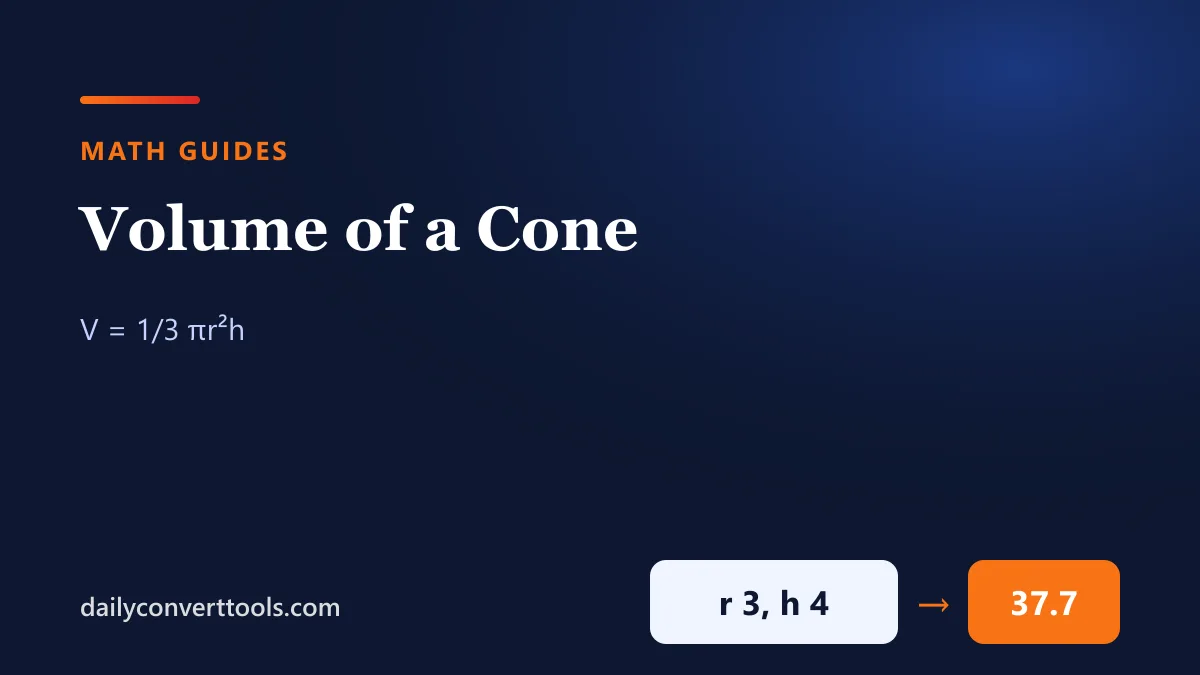
V = 1/3 × π × r² × h
Example: radius 3 cm, height 4 cm. V = 1/3 × π × 9 × 4 = 12π ≈ 37.7 cm³.
Step by step
- First, find the radius of the base (half the diameter).
- Then square it and multiply by π for the base area.
- Next, multiply by the height (straight up from the base to the tip, not along the side).
- Finally, divide by 3.
Examples
| Object | Radius | Height | Volume |
|---|---|---|---|
| Ice-cream cone | 2.5 cm | 11 cm | 72.0 cm³ |
| Traffic cone | 18 cm | 70 cm | 23,750 cm³ (23.8 L) |
| Sand pile | 1.5 m | 1 m | 2.36 m³ |
| Funnel | 6 cm | 8 cm | 302 cm³ |
Height vs slant height
The formula uses the vertical height h. If you only know the slant height s (along the side), use the Pythagorean theorem: h = √(s² − r²). A cone with r = 3 and s = 5 has h = √(25 − 9) = 4.
Surface area of a cone
Surface area = π × r² + π × r × s (base plus curved side). For r = 3 and s = 5: 9π + 15π = 24π ≈ 75.4 cm². Leave out the πr² term for an open cone like a funnel or party hat.
Frustum (cone with the top cut off)
Buckets and lampshades are frustums. Their volume is V = 1/3 × π × h × (R² + Rr + r²), where R and r are the two radii.
Compare with the volume of a cylinder and volume of a sphere.
Frequently asked questions
What is the formula for the volume of a cone?
V = 1/3 πr²h.
Why is a cone a third of a cylinder?
A cone with the same base and height as a cylinder holds exactly one third as much; it can be shown with calculus or by filling them with water.
What’s the difference between height and slant height?
Height is measured straight up from the base; slant height runs along the side.
What is the surface area of a cone?
πr² + πrs, where s is the slant height.