Volume of a Sphere: Formula, Examples and Surface Area
A sphere is a perfectly round 3D shape, like a ball or a bubble. Its volume depends only on its radius: the distance from the centre to the surface.
Quick answer
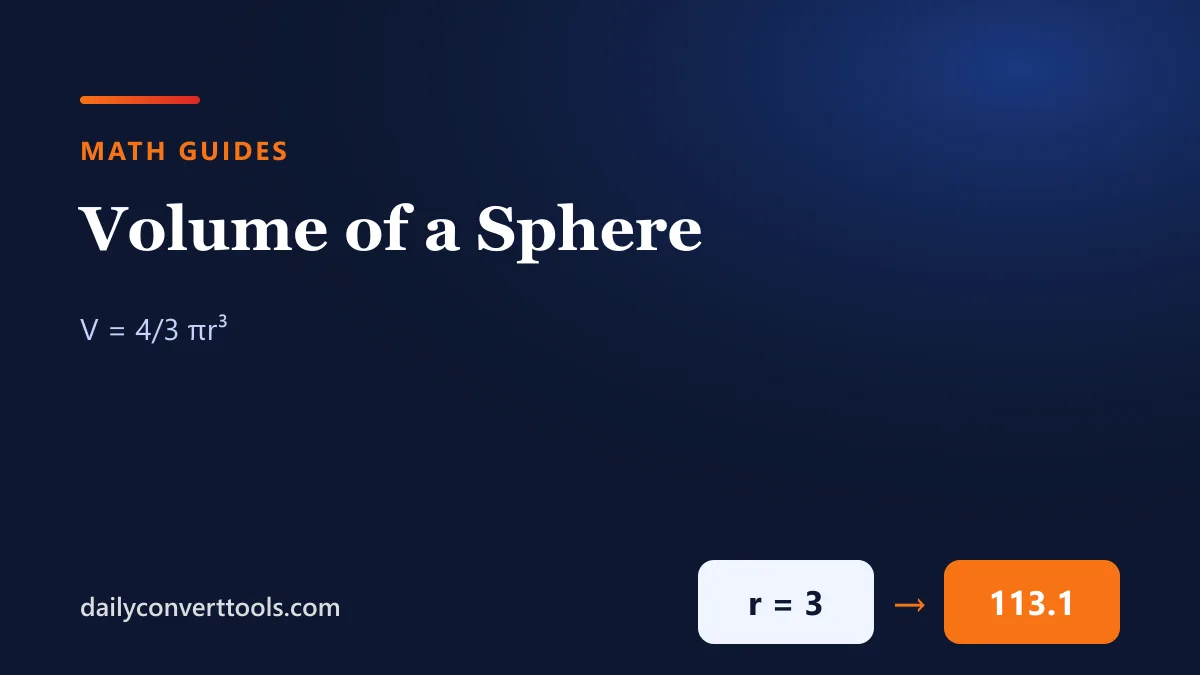
V = 4/3 × π × r³
Example: a sphere with radius 3 cm has V = 4/3 × π × 27 = 36π ≈ 113.1 cm³.
Step by step
- First, find the radius (half the diameter).
- Then cube it: r × r × r.
- Next, multiply by π.
- Finally, multiply by 4 and divide by 3.
Examples
| Object | Diameter | Radius | Volume |
|---|---|---|---|
| Marble | 1.6 cm | 0.8 cm | 2.14 cm³ |
| Tennis ball | 6.7 cm | 3.35 cm | 157 cm³ |
| Basketball | 24 cm | 12 cm | 7,238 cm³ (7.2 L) |
| Spherical tank | 2 m | 1 m | 4.189 m³ (4,189 L) |
From the diameter
Using the diameter directly: V = π × d³ ÷ 6. For d = 10 in: π × 1,000 ÷ 6 ≈ 523.6 cu in.
Hemispheres and domes
A hemisphere is half a sphere, so V = 2/3 × π × r³. A dome with radius 4 m holds about 134.0 m³ of air.
Surface area of a sphere
Surface area = 4 × π × r². For r = 3 cm: 36π ≈ 113.1 cm². (At r = 3, the volume and surface area happen to share the number 36π, but their units differ.)
Doubling the size
Because the radius is cubed, doubling a sphere’s radius makes its volume 8 times bigger, while its surface area grows 4 times.
Other shapes: volume of a cylinder and volume of a cone. For converting units, see how to calculate cubic feet.
Frequently asked questions
What is the formula for the volume of a sphere?
V = 4/3 πr³.
How do I find the volume from the diameter?
Use V = πd³ ÷ 6, or halve the diameter first.
What is the surface area of a sphere?
4πr².
What is the volume of a hemisphere?
2/3 πr³.