kPa to PSI (and PSI to kPa): Formula and Chart
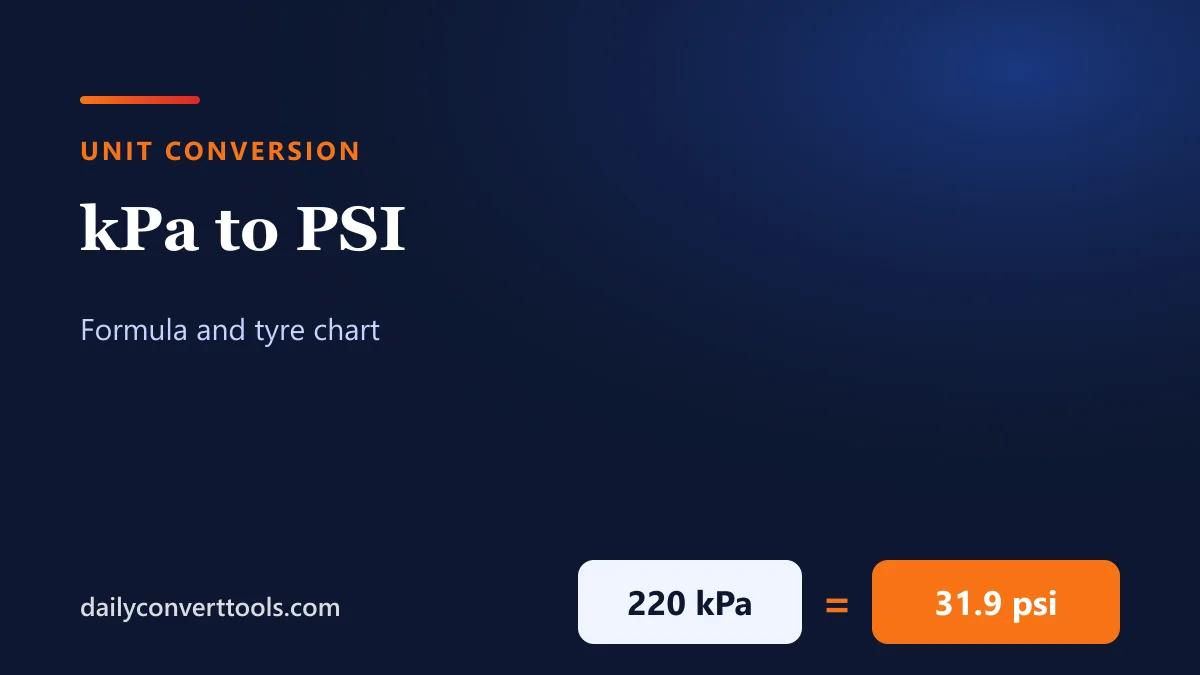
Canada, Australia and many car manuals list tyre pressures in kilopascals (kPa), while US gauges use psi. 1 psi is about 6.9 kPa, so 220 kPa is roughly 32 psi.
Quick answer
- psi = kPa × 0.14504 (or kPa ÷ 6.895)
- kPa = psi × 6.894757
- 100 kPa = 1 bar ≈ 14.5 psi
The factor 6.894757 kPa per psi comes from NIST Guide to the SI, Appendix B.9.
kPa to psi chart
| kPa | psi |
|---|---|
| 100 | 14.5 |
| 150 | 21.8 |
| 180 | 26.1 |
| 200 | 29.0 |
| 210 | 30.5 |
| 220 | 31.9 |
| 230 | 33.4 |
| 240 | 34.8 |
| 250 | 36.3 |
| 260 | 37.7 |
| 280 | 40.6 |
| 300 | 43.5 |
| 350 | 50.8 |
| 400 | 58.0 |
| 500 | 72.5 |
psi to kPa chart
| psi | kPa |
|---|---|
| 10 | 68.9 |
| 20 | 137.9 |
| 26 | 179.3 |
| 28 | 193.1 |
| 30 | 206.8 |
| 32 | 220.6 |
| 35 | 241.3 |
| 36 | 248.2 |
| 40 | 275.8 |
| 45 | 310.3 |
| 50 | 344.7 |
| 60 | 413.7 |
| 100 | 689.5 |
kPa in weather and science
Air pressure is also measured in kPa (or hectopascals, hPa, where 10 hPa = 1 kPa). Standard sea-level pressure is 101.325 kPa (1,013.25 hPa), or about 14.7 psi. Weather maps usually show hPa, also called millibars.
Checking your tyres
- Use the pressure on the sticker inside the driver’s door or in the manual; it may be listed in kPa, psi and bar.
- Check tyres when they’re cold, as pressure rises as they warm up.
- Many gauges switch units with a button; set it to match your spec rather than converting in your head.
For bar, see bar to psi.
A quick mental trick
kPa to psi: divide by 7 for a figure about 1.5% low. For 240 kPa: about 34 psi (exact: 34.8).
Frequently asked questions
How many psi is 1 kPa?
0.145 psi.
How many kPa is 32 psi?
220.6 kPa.
What is 250 kPa in psi?
36.3 psi.
How many kPa are in a bar?
100 kPa.