BTU to Watts and kW (Plus BTU per Ton of Cooling)
Air conditioners and heaters in the US are rated in BTU (British thermal units per hour), while much of the world uses watts or kilowatts. Here’s how to compare them.
Quick answer
- watts = BTU/h × 0.29307
- BTU/h = watts × 3.4121
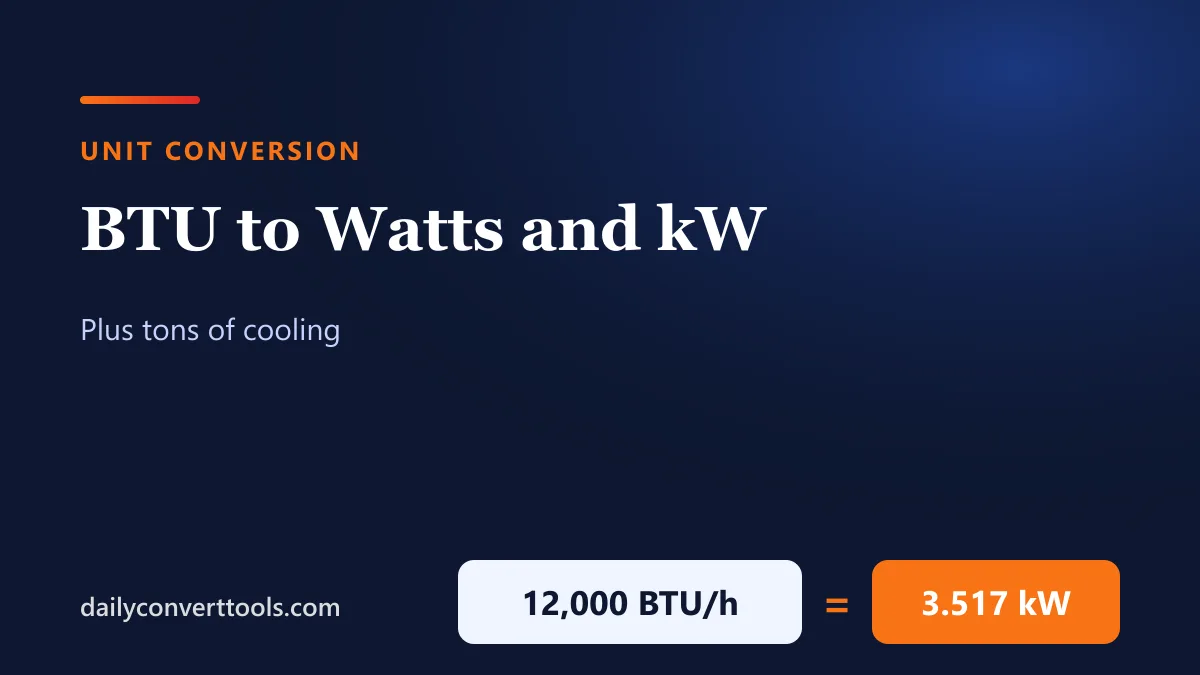
- 1 ton of cooling = 12,000 BTU/h = 3.517 kW
NIST lists the international BTU as 1,055.056 J and a ton of refrigeration as 3,516.853 W (NIST Guide to the SI, Appendix B.9). An appliance’s “BTU” rating almost always means BTU per hour.
BTU/h to watts chart
| BTU/h | Watts | kW |
|---|---|---|
| 1,000 | 293 | 0.29 |
| 5,000 | 1,465 | 1.47 |
| 6,000 | 1,758 | 1.76 |
| 8,000 | 2,345 | 2.34 |
| 10,000 | 2,931 | 2.93 |
| 12,000 | 3,517 | 3.52 |
| 15,000 | 4,396 | 4.40 |
| 18,000 | 5,275 | 5.28 |
| 24,000 | 7,034 | 7.03 |
| 30,000 | 8,792 | 8.79 |
| 36,000 | 10,551 | 10.55 |
| 48,000 | 14,067 | 14.07 |
| 60,000 | 17,584 | 17.58 |
Watts to BTU/h
| Watts | BTU/h |
|---|---|
| 500 | 1,706 |
| 750 | 2,559 |
| 1,000 | 3,412 |
| 1,500 | 5,118 |
| 2,000 | 6,824 |
| 2,500 | 8,530 |
| 3,500 | 11,942 |
| 5,000 | 17,061 |
What’s a “ton” of air conditioning?
A ton of cooling is the heat needed to melt one short ton of ice in 24 hours: 12,000 BTU per hour. So a 3-ton central AC unit removes about 36,000 BTU/h (10.6 kW) of heat. It has nothing to do with the unit’s weight.
| Tons | BTU/h | kW of cooling |
|---|---|---|
| 1 | 12,000 | 3.52 |
| 1.5 | 18,000 | 5.28 |
| 2 | 24,000 | 7.03 |
| 2.5 | 30,000 | 8.79 |
| 3 | 36,000 | 10.55 |
| 4 | 48,000 | 14.07 |
| 5 | 60,000 | 17.58 |
Cooling output vs electricity used
An air conditioner’s BTU rating describes the heat it moves, not the electricity it uses. Because heat pumps move more heat than they consume, a 12,000 BTU/h (3.5 kW cooling) unit might draw only about 1 kW of electricity, depending on its efficiency rating (EER or SEER). Check the label for actual power use; for amps, see watts to amps.
A quick mental trick
BTU/h to watts: divide by 3.4. For 10,000 BTU/h: about 2,940 W (exact: 2,931).
Frequently asked questions
How many watts is 1 BTU?
0.293 watts per BTU/h.
How many BTU are in a ton?
12,000 BTU per hour.
How many kW is 12,000 BTU?
3.52 kW.
How many BTU is 1 kW?
3,412 BTU/h.