Point-Slope Form: Equation of a Line From a Point and a Slope
Point-slope form is the quickest way to write the equation of a straight line when you know its slope and any one point on it.
Quick answer
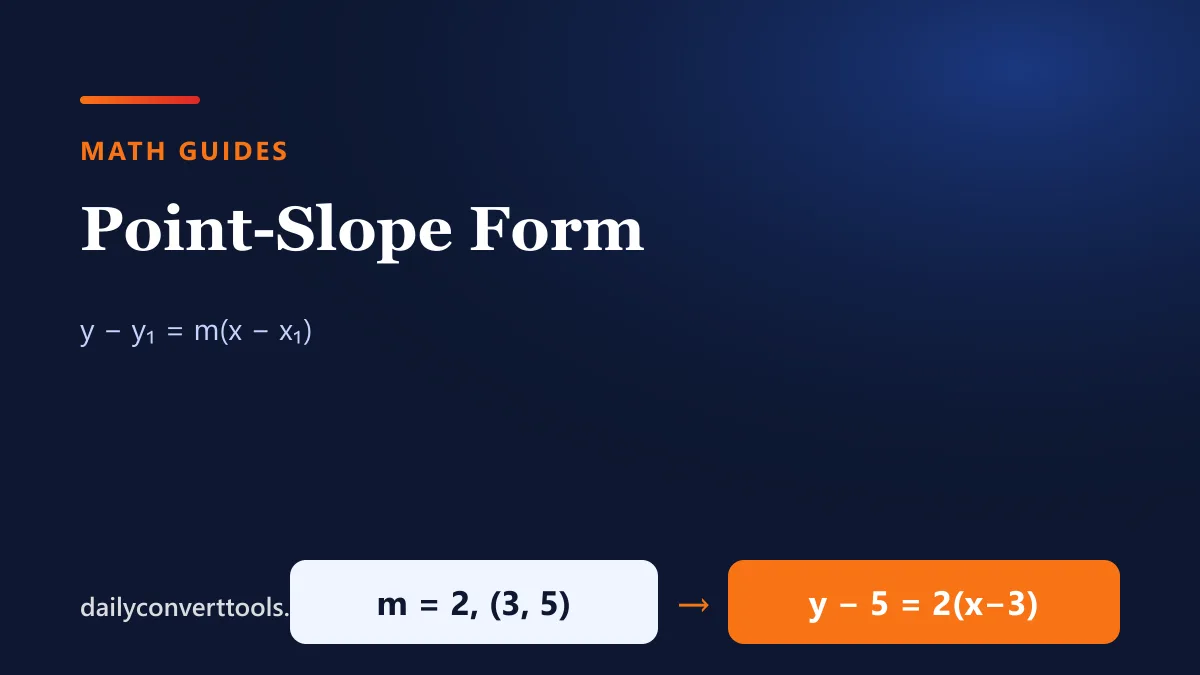
y − y₁ = m(x − x₁)
- m is the slope; (x₁, y₁) is a known point on the line.
- Example: slope 2 through (3, 5) gives y − 5 = 2(x − 3).
- Simplified to slope-intercept form, that’s y = 2x − 1.
From a point and a slope
- First, write the formula: y − y₁ = m(x − x₁).
- Then substitute the slope and the point. For m = −3 through (−2, 4): y − 4 = −3(x − (−2)).
- Finally, tidy the signs: y − 4 = −3(x + 2).
From two points
- First, find the slope with the slope formula: through (1, 2) and (4, 11), m = (11 − 2) ÷ (4 − 1) = 3.
- Then use either point: y − 2 = 3(x − 1).
- Using the other point, y − 11 = 3(x − 4), describes the same line.
Converting to slope-intercept form
Expand and solve for y. From y − 2 = 3(x − 1): y − 2 = 3x − 3, so y = 3x − 1. See slope-intercept form.
Examples
| Slope | Point | Point-slope form | Slope-intercept form |
|---|---|---|---|
| 2 | (3, 5) | y − 5 = 2(x − 3) | y = 2x − 1 |
| -1 | (0, 4) | y − 4 = -1x | y = -1x + 4 |
| 0.5 | (2, -3) | y + 3 = 0.5(x − 2) | y = 0.5x − 4 |
| 4 | (-1, -2) | y + 2 = 4(x + 1) | y = 4x + 2 |
| -2 | (5, 0) | y = -2(x − 5) | y = -2x + 10 |
Special cases
- A horizontal line has slope 0: y − y₁ = 0, so y = y₁.
- A vertical line has an undefined slope, so it can’t be written in point-slope form; its equation is x = x₁.
Frequently asked questions
What is point-slope form?
y − y₁ = m(x − x₁), where m is the slope and (x₁, y₁) is a point on the line.
When should I use point-slope form?
When you know the slope and one point, or two points on the line.
How do I convert point-slope to slope-intercept form?
Expand the brackets and solve for y.
Can I use either point?
Yes. Both give equations for the same line.