Acceleration Formula (a = Δv ÷ t) and Velocity Formula, With Examples
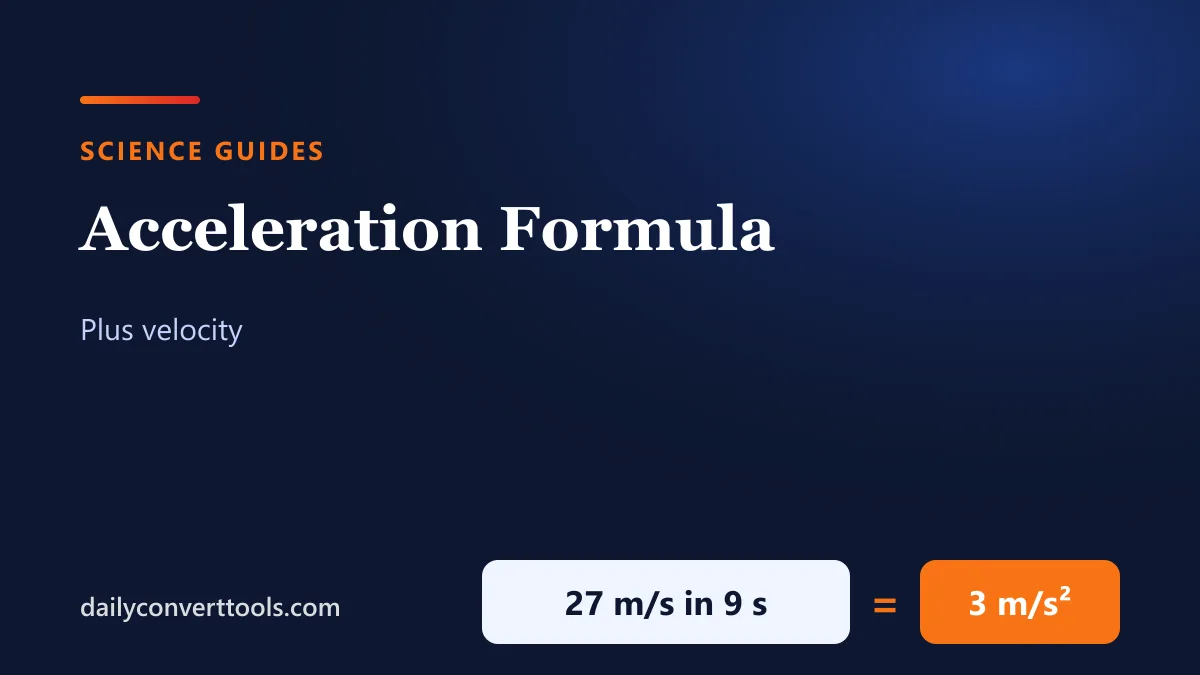
Acceleration is how quickly velocity changes. A car going from 0 to 100 km/h in 6 seconds accelerates faster than one taking 12 seconds.
Quick answer
- Acceleration: a = (v − u) ÷ t, where u is the starting velocity, v the final velocity and t the time.
- Velocity: v = displacement ÷ time (average velocity), or v = u + at.
- Units: acceleration in m/s² (metres per second, per second); velocity in m/s.
Worked example
A car goes from rest to 27 m/s (about 97 km/h) in 9 seconds.
- First, the change in velocity: 27 − 0 = 27 m/s.
- Then divide by the time: 27 ÷ 9 = 3 m/s².
- So every second, the car’s speed increases by 3 m/s.
Deceleration
When an object slows down, the acceleration is negative. A cyclist braking from 8 m/s to 2 m/s in 3 seconds has a = (2 − 8) ÷ 3 = −2 m/s².
Speed vs velocity
Speed is how fast; velocity is speed in a particular direction. Running a 400 m lap in 80 s is an average speed of 5 m/s, but your average velocity is zero because you finish where you started. Acceleration is about velocity, so even turning a corner at a steady speed counts as accelerating.
Equations of motion (constant acceleration)
| Equation | Use it when you know |
|---|---|
| v = u + at | Start velocity, acceleration, time |
| s = ut + ½at² | Start velocity, acceleration, time (to find distance) |
| v² = u² + 2as | Velocities and acceleration, no time |
| s = (u + v) ÷ 2 × t | Start and end velocity, time |
Example: the car above covers s = 0 × 9 + ½ × 3 × 81 = 121.5 m while accelerating.
Gravity and g-forces
Near Earth’s surface, falling objects accelerate at about 9.81 m/s² (standard gravity is defined as 9.80665 m/s²), ignoring air resistance. Accelerations are sometimes given in g: 3 m/s² is about 0.31 g.
Unit conversions
To use km/h or mph, convert to m/s first: km/h ÷ 3.6 = m/s. See mph to km/h and m/s to mph. For pace and running speed, see running pace.
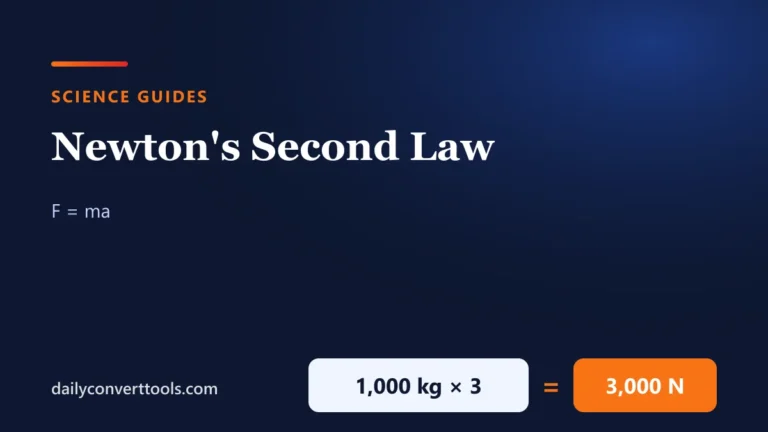
The force behind acceleration is covered in Newton’s second law.
Frequently asked questions
What is the formula for acceleration?
a = (final velocity − initial velocity) ÷ time.
What is the unit of acceleration?
Metres per second squared (m/s²).
What is negative acceleration?
Slowing down, also called deceleration.
What is the difference between speed and velocity?
Velocity includes direction; speed doesn’t.