MM to Meters (and Meters to MM): 1,000 mm in a Meter
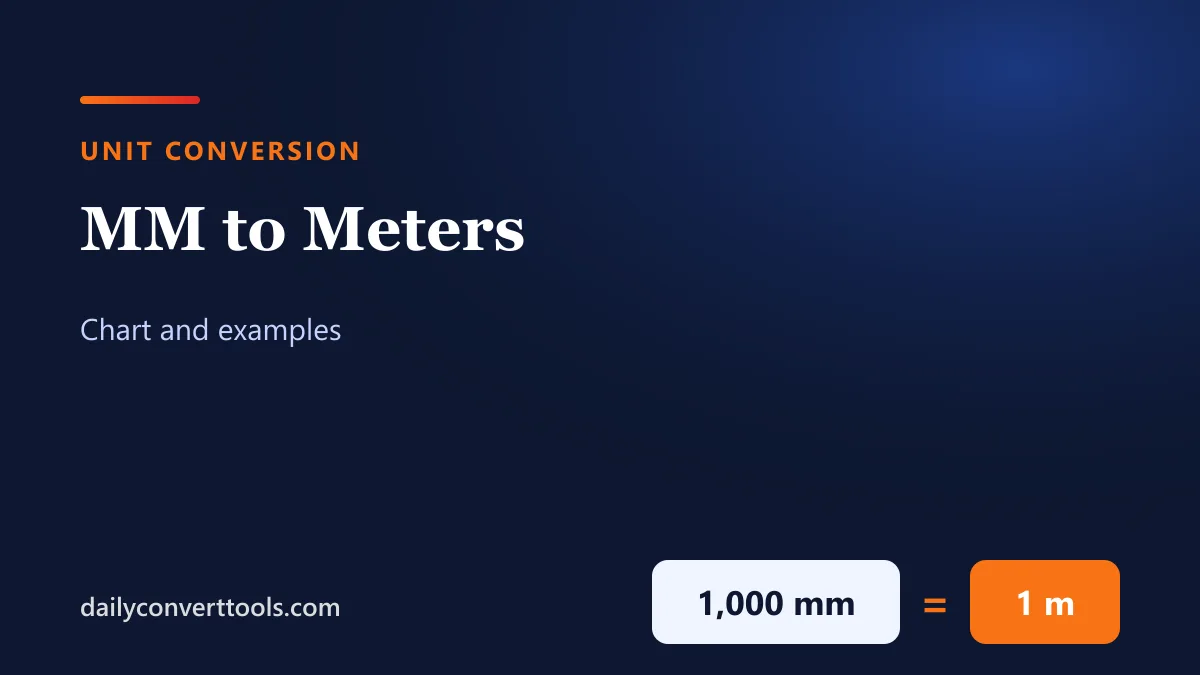
Engineers, builders and product designers often measure everything in millimetres, while everyday lengths use metres. The prefix milli- means one thousandth, so 1 metre = 1,000 millimetres. To convert mm to m, divide by 1,000.
Quick answer
- m = mm ÷ 1,000
- mm = m × 1,000
- 1 mm = 0.001 m; 1 cm = 10 mm
mm to m chart
| Millimetres | Metres |
|---|---|
| 1 mm | 0.001 m |
| 10 mm | 0.01 m |
| 50 mm | 0.05 m |
| 100 mm | 0.1 m |
| 250 mm | 0.25 m |
| 500 mm | 0.5 m |
| 600 mm | 0.6 m |
| 750 mm | 0.75 m |
| 900 mm | 0.9 m |
| 1,000 mm | 1 m |
| 1,200 mm | 1.2 m |
| 1,500 mm | 1.5 m |
| 2,400 mm | 2.4 m |
| 3,000 mm | 3 m |
| 5,000 mm | 5 m |
m to mm chart
| Metres | Millimetres |
|---|---|
| 0.01 m | 10 mm |
| 0.1 m | 100 mm |
| 0.25 m | 250 mm |
| 0.5 m | 500 mm |
| 0.75 m | 750 mm |
| 1 m | 1,000 mm |
| 1.2 m | 1,200 mm |
| 1.8 m | 1,800 mm |
| 2.4 m | 2,400 mm |
| 3 m | 3,000 mm |
| 5 m | 5,000 mm |
Why builders use millimetres
Using a single unit avoids decimal points and mix-ups on drawings. A standard sheet of plasterboard might be written as 2,400 × 1,200 mm rather than 2.4 × 1.2 m, and kitchen cabinets are commonly specified as 600 mm wide. When converting, just move the decimal point three places: 2,400 mm → 2.4 m.
The mm to m decimal shortcut
- mm → m: move the decimal point three places left. 750 mm → 0.75 m; 45 mm → 0.045 m.
- m → mm: move it three places right. 1.25 m → 1,250 mm.
For centimetres, see cm to mm and cm to m. The metric prefixes are exact (see NIST Handbook 44, Appendix C).
Common mistakes
- Moving the decimal point two places (that’s cm to m).
- Dropping the leading zero: write 0.045 m, not .045 m.
- Areas: 1 m² = 1,000,000 mm², not 1,000 mm².
Frequently asked questions
How many mm are in a meter?
1,000 millimetres.
How many meters is 500 mm?
0.5 metres.
How many mm is 1.5 m?
1,500 millimetres.
How many mm in a cm?
10 millimetres.