Calories to kJ (and kJ to Calories): Food Label Chart
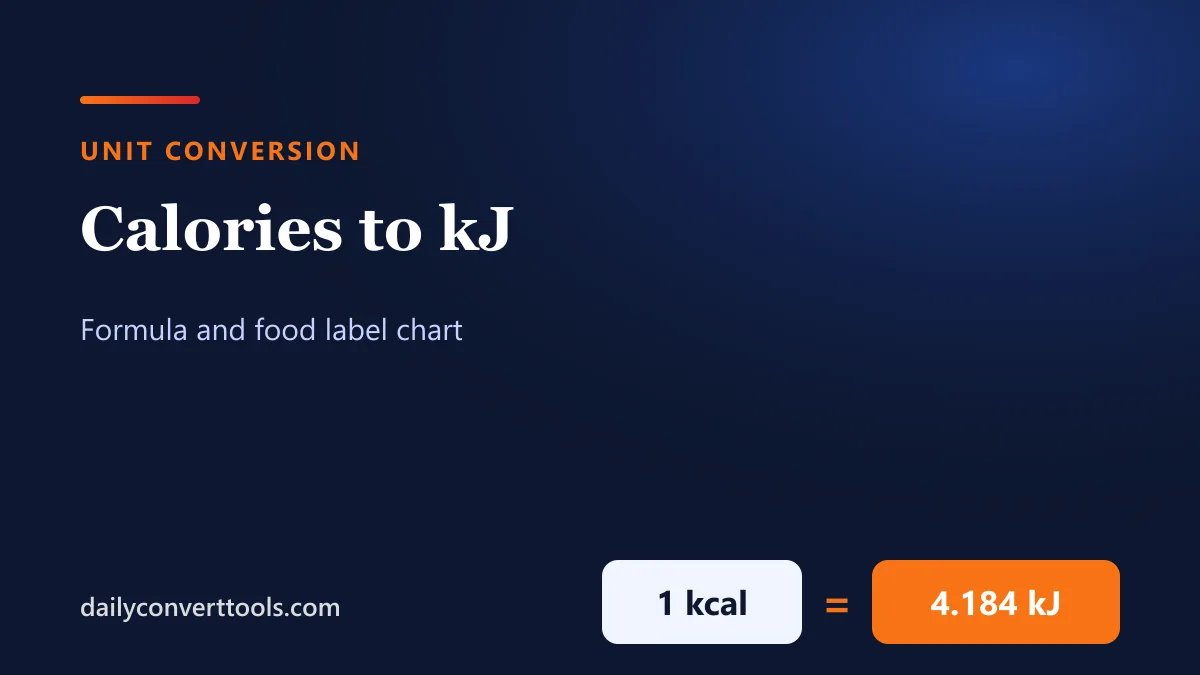
Food labels in the US show Calories, while Australia, New Zealand and the EU show kilojoules (often alongside kcal). The conversion is simple: 1 kilocalorie = 4.184 kilojoules.
Quick answer
- kJ = kcal × 4.184
- kcal = kJ ÷ 4.184
- A food “Calorie” (capital C) is a kilocalorie (kcal), not a small calorie.
Calories vs kilocalories
Scientists distinguish the small calorie (cal), the energy to warm 1 gram of water by 1 °C, from the kilocalorie (kcal), which is 1,000 cal. On food labels, “Calories” always means kilocalories. The thermochemical calorie is defined as exactly 4.184 joules, so 1 kcal = 4.184 kJ.
Calories to kJ chart
| Calories (kcal) | Kilojoules (kJ) |
|---|---|
| 1 | 4.2 |
| 50 | 209.2 |
| 100 | 418.4 |
| 150 | 627.6 |
| 200 | 836.8 |
| 250 | 1,046 |
| 300 | 1,255.2 |
| 400 | 1,673.6 |
| 500 | 2,092 |
| 750 | 3,138 |
| 1,000 | 4,184 |
| 1,500 | 6,276 |
| 2,000 | 8,368 |
| 2,500 | 10,460 |
kJ to Calories chart
| Kilojoules (kJ) | Calories (kcal) |
|---|---|
| 100 | 24 |
| 250 | 60 |
| 500 | 120 |
| 1,000 | 239 |
| 1,500 | 359 |
| 2,000 | 478 |
| 3,000 | 717 |
| 5,000 | 1,195 |
| 8,700 | 2,079 |
| 10,000 | 2,390 |
8,700 kJ (about 2,079 kcal) is the average adult daily intake used on Australian and New Zealand labels; US labels use 2,000 Calories as a reference.
A quick mental trick
kcal to kJ: multiply by 4, then add 5%. For 250 kcal: 1,000 + 50 = 1,050 kJ (exact: 1,046). kJ to kcal: divide by 4, then subtract 5%.
Reading food labels
- EU labels list energy per 100 g in both kJ and kcal, for example “1,046 kJ / 250 kcal”.
- Australian labels list kJ per serving and per 100 g.
- If a label shows only kJ, divide by 4.184 to compare with US Calorie counts.
Frequently asked questions
How many kJ are in a calorie?
4.184 kJ per food Calorie (kcal).
How many calories is 1,000 kJ?
About 239 kcal.
Is a Calorie the same as a kcal?
Yes. Food “Calories” are kilocalories.
How many kJ is 2,000 calories?
8,368 kJ.