Probability Formula: How to Calculate Probability (With Examples)
Probability measures how likely something is, on a scale from 0 (impossible) to 1 (certain). For events where every outcome is equally likely, the formula is simple.
Quick answer
P(event) = number of favourable outcomes ÷ total number of outcomes
- Rolling a 6 on a die: 1 ÷ 6 ≈ 0.167, or about 16.7%.
- Drawing a heart from a 52-card deck: 13 ÷ 52 = 1/4 = 25%.
- Probabilities of all possible outcomes add up to 1.
Examples
| Event | Favourable | Total | Probability |
|---|---|---|---|
| Heads on a coin | 1 | 2 | 1/2 = 50% |
| Even number on a die | 3 | 6 | 1/2 = 50% |
| An ace from a deck | 4 | 52 | 1/13 ≈ 7.7% |
| A face card (J, Q, K) | 12 | 52 | 3/13 ≈ 23.1% |
| Total of 7 with two dice | 6 | 36 | 1/6 ≈ 16.7% |
The complement: “not”
P(not A) = 1 − P(A). The chance of not rolling a 6 is 1 − 1/6 = 5/6.
“And”: both events happen
For independent events, multiply: P(A and B) = P(A) × P(B). Two heads in a row: 1/2 × 1/2 = 1/4. Three sixes in a row: (1/6)³ = 1/216.
If the first event changes the second (drawing cards without replacing them), adjust the second probability: two aces in a row = 4/52 × 3/51 = 1/221.
“Or”: either event happens
P(A or B) = P(A) + P(B) − P(A and B). Drawing a heart or a king: 13/52 + 4/52 − 1/52 = 16/52 = 4/13. Subtract the overlap (the king of hearts) so it isn’t counted twice. If the events can’t happen together, just add.
“At least one”
Use the complement. The chance of at least one 6 in four rolls is 1 − (5/6)⁴ ≈ 51.8%.
Probability, percentages and odds
- As a percentage: multiply by 100. 1/4 = 25%; see percent to decimal.
- As odds: favourable to unfavourable. A 1/6 chance is odds of 1 to 5.
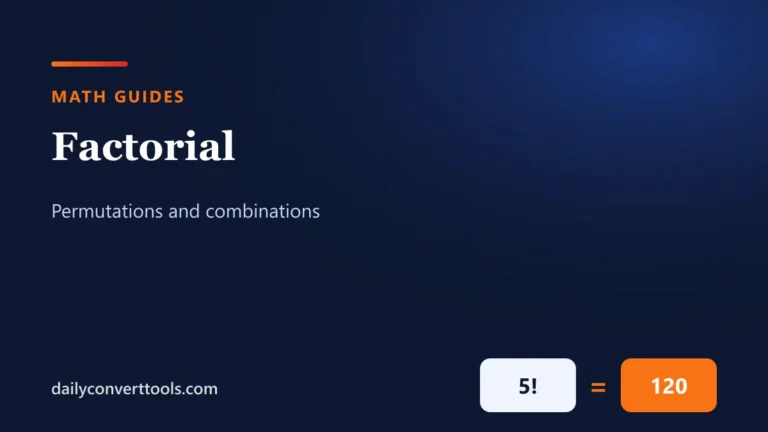
- Counting large numbers of outcomes uses factorials; see factorials, permutations and combinations.
Frequently asked questions
What is the probability formula?
Favourable outcomes ÷ total outcomes, when all outcomes are equally likely.
What is the probability of rolling a 6?
1/6, about 16.7%.
How do I find the probability of two events both happening?
For independent events, multiply their probabilities.
Can a probability be more than 1?
No. It’s always between 0 and 1.