Newton’s Second Law (F = ma): Force Formula With Examples
Newton’s second law of motion explains how forces change the way things move. The bigger the force, the faster an object speeds up; the heavier the object, the harder it is to accelerate.
Quick answer
| To find | Formula | Example |
|---|---|---|
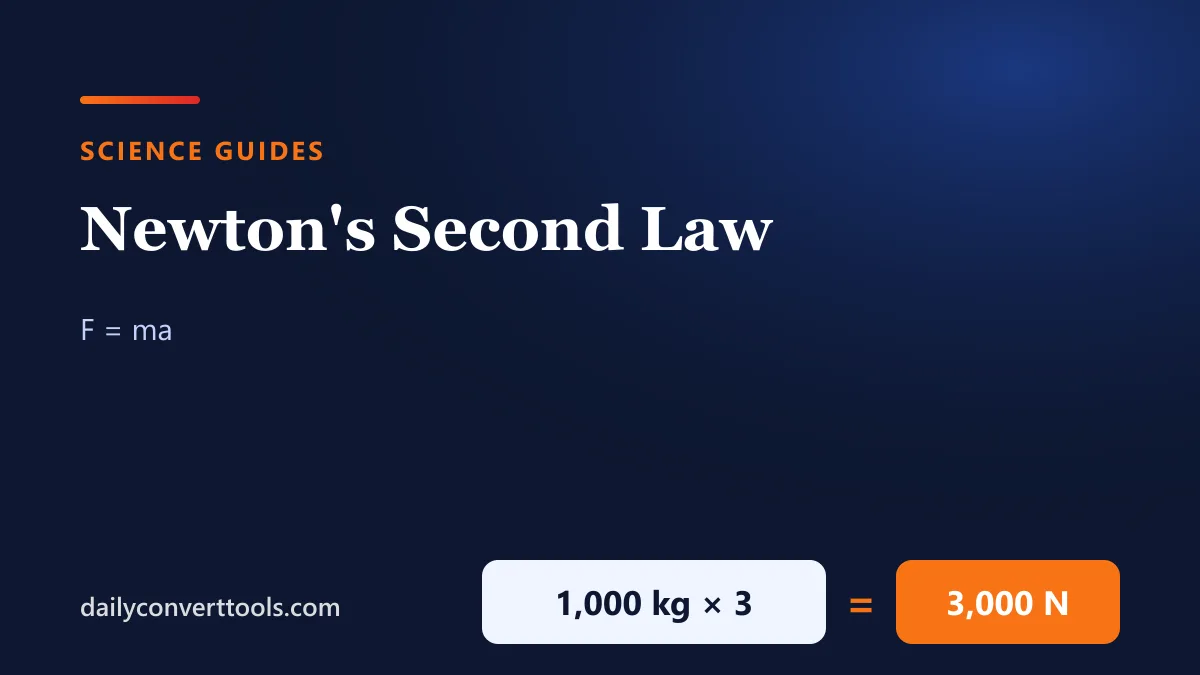
| Force | F = m × a | 1,000 kg × 3 m/s² = 3,000 N |
| Acceleration | a = F ÷ m | 500 N ÷ 50 kg = 10 m/s² |
| Mass | m = F ÷ a | 200 N ÷ 4 m/s² = 50 kg |
Force is in newtons (N), mass in kilograms (kg) and acceleration in metres per second squared (m/s²). One newton is the force that accelerates 1 kg at 1 m/s².
Weight is a force: W = mg
Weight is mass times the acceleration due to gravity. Standard gravity is 9.80665 m/s² (often rounded to 9.8 or 9.81), so a 70 kg person weighs about 70 × 9.81 ≈ 686 N on Earth. On the Moon, where gravity is about a sixth as strong, the mass is still 70 kg but the weight is much less. For pounds-force, see newtons to pounds.
Worked examples
- Car: a 1,200 kg car accelerates at 2.5 m/s². Net force = 1,200 × 2.5 = 3,000 N.
- Kicked ball: a 0.45 kg ball pushed with 90 N accelerates at 90 ÷ 0.45 = 200 m/s² while the foot is in contact.
- Lift: to accelerate a 500 kg lift upward at 1 m/s², the cable must supply its weight (500 × 9.81 ≈ 4,903 N) plus 500 × 1 = 500 N, about 5,403 N in total.
Net force
F in F = ma is the net (total) force. If you push a box with 100 N and friction pushes back with 40 N, the net force is 60 N. If the net force is zero, the object keeps moving at a constant velocity, or stays still (Newton’s first law).
Newton’s three laws
- An object stays at rest or moves at constant velocity unless a net force acts on it.
- Net force equals mass times acceleration (F = ma).
- For every action there’s an equal and opposite reaction.
For speeding up and slowing down, see the acceleration formula; for energy of motion, see the kinetic energy formula.
Frequently asked questions
What is Newton’s second law?
Force equals mass times acceleration: F = ma.
What unit is force measured in?
Newtons (N); 1 N = 1 kg·m/s².
What is the difference between mass and weight?
Mass is the amount of matter (kg); weight is the force of gravity on it (N).
How much does 1 kg weigh in newtons?
About 9.81 N on Earth.