Density Formula (ρ = m ÷ V): How to Calculate Density, With Examples
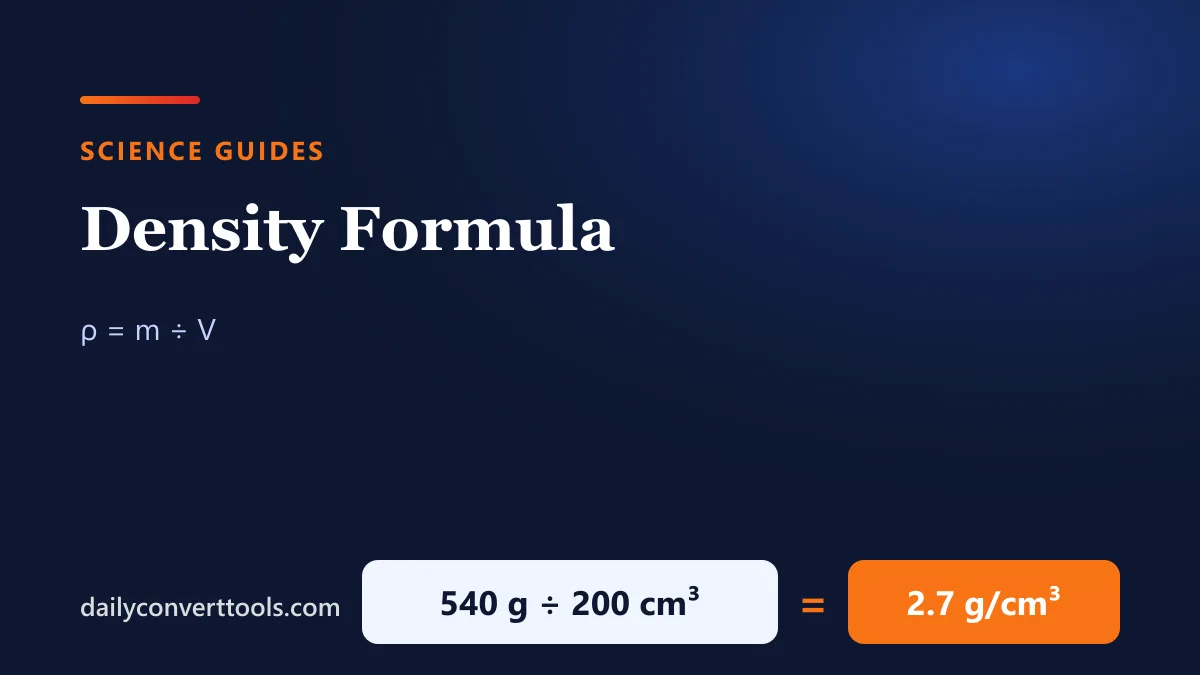
Density tells you how much mass is packed into a given volume. A brick and a sponge the same size have very different densities, which is why one sinks and the other floats.
Quick answer
| To find | Formula | Example |
|---|---|---|
| Density | ρ = m ÷ V | 540 g ÷ 200 cm³ = 2.7 g/cm³ |
| Mass | m = ρ × V | 2.7 g/cm³ × 50 cm³ = 135 g |
| Volume | V = m ÷ ρ | 135 g ÷ 2.7 g/cm³ = 50 cm³ |
ρ is the Greek letter rho, often used for density.
Units
- g/cm³ (same as g/ml): common in school science.
- kg/m³: the SI unit. 1 g/cm³ = 1,000 kg/m³.
- lb/ft³: used in US engineering. 1 g/cm³ ≈ 62.4 lb/ft³.
Step-by-step example
A metal block measures 2 cm × 3 cm × 5 cm and has a mass of 237 g.
- First, find the volume: 2 × 3 × 5 = 30 cm³ (see volume of a rectangular prism).
- Then divide: 237 ÷ 30 = 7.9 g/cm³.
- Finally, compare with known densities: that’s close to iron or steel.
Measuring the volume of an odd shape
Use water displacement: fill a measuring cylinder, note the level, drop the object in, and read the new level. The rise is the object’s volume (1 ml = 1 cm³). A stone that raises the water from 50 ml to 72 ml has a volume of 22 cm³.
Approximate densities of common materials
| Material | Approx. density (g/cm³) |
|---|---|
| Air (sea level, room temperature) | about 0.0012 |
| Cork | about 0.24 |
| Ice | about 0.92 |
| Water (4 °C) | about 1.00 |
| Seawater | about 1.03 |
| Aluminium | about 2.7 |
| Iron | about 7.9 |
| Copper | about 9.0 |
| Gold | about 19.3 |
Values vary with temperature, purity and alloy.
Floating and sinking
An object floats in a liquid if its average density is lower than the liquid’s. Ice (about 0.92) floats on water (1.00), with about 92% of it below the surface. Steel ships float because their hollow hulls give them a low average density.
For how much a volume of water weighs, see how much a gallon of water weighs.
Frequently asked questions
What is the formula for density?
Density = mass ÷ volume.
What is the density of water?
About 1 g/cm³ (1,000 kg/m³) at 4 °C.
How do I convert g/cm³ to kg/m³?
Multiply by 1,000.
Why does ice float?
Ice is less dense than liquid water.