Golden Ratio (φ ≈ 1.618): What It Is, Formula and Examples
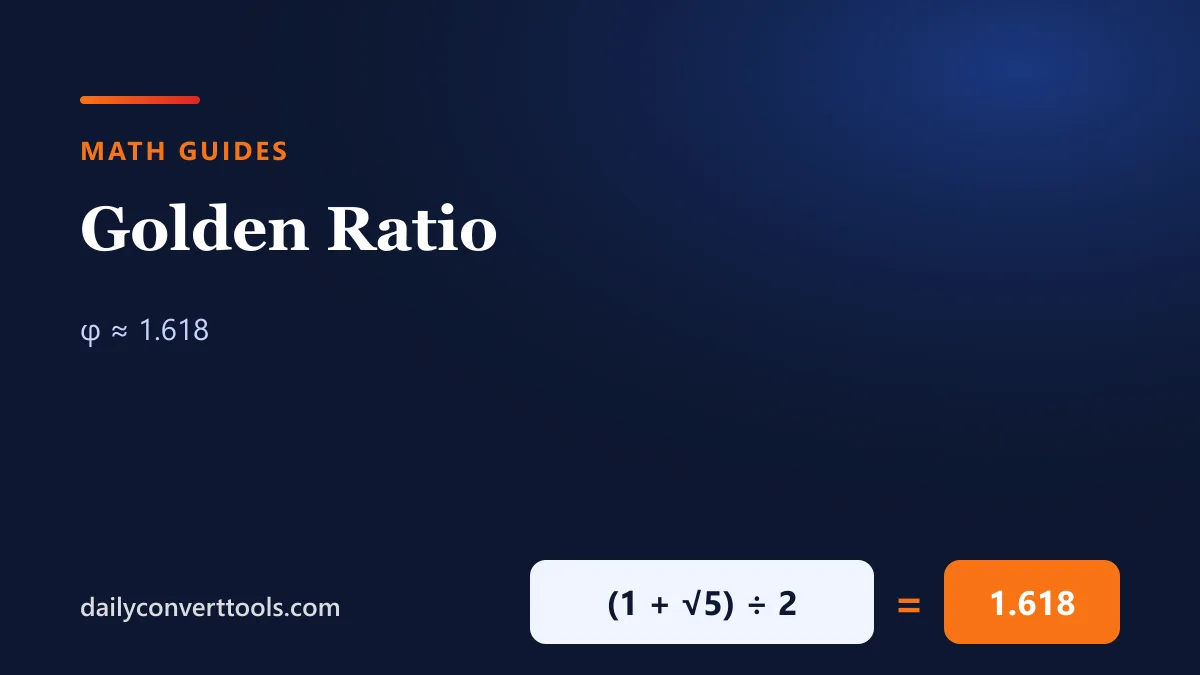
The golden ratio, written with the Greek letter φ (phi), is about 1.618. Two quantities are in the golden ratio if the ratio of the larger to the smaller equals the ratio of their sum to the larger.
Quick answer
- φ = (1 + √5) ÷ 2 ≈ 1.6180339887
- If a ÷ b = φ, then (a + b) ÷ a = φ too.
- φ² = φ + 1 ≈ 2.618, and 1 ÷ φ = φ − 1 ≈ 0.618.
Where the formula comes from
Set the larger part to φ and the smaller to 1. The definition says φ ÷ 1 = (φ + 1) ÷ φ, which rearranges to φ² − φ − 1 = 0. The quadratic formula gives φ = (1 + √5) ÷ 2, taking the positive answer.
Golden ratio and Fibonacci
Ratios of consecutive Fibonacci numbers approach φ: 8 ÷ 5 = 1.6, 13 ÷ 8 = 1.625, 89 ÷ 55 ≈ 1.61818.
Using the golden ratio
| If the short side is | Golden long side (× 1.618) |
|---|---|
| 5 | 8.09 |
| 8 | 12.94 |
| 10 | 16.18 |
| 12 | 19.42 |
| 20 | 32.36 |
| 100 | 161.80 |
| 1080 | 1,747.48 |
- Layouts: a 960 px page split in the golden ratio gives columns of about 593 px and 367 px.
- Typography: some designers scale heading sizes by 1.618 (16 px body → about 26 px headings).
- Golden rectangle: sides in the ratio 1 : 1.618. Cutting a square off one end leaves another golden rectangle.
Myths and reality
The golden ratio has a reputation for being everywhere, but many claims don’t hold up. Measurements of the Parthenon, the Mona Lisa or the “perfect” face depend on which points you choose, and often fit other ratios just as well. Sunflower seed spirals do relate to Fibonacci numbers, but many natural shapes don’t. Treat it as a useful design proportion, not a universal law.
Compared with other ratios
| Ratio | Value | Example |
|---|---|---|
| Golden ratio | 1.618 | Golden rectangle |
| 16:9 | 1.778 | Widescreen video |
| 3:2 | 1.500 | 35 mm photos |
| √2 (A-series paper) | 1.414 | A4 paper |
See the aspect ratio guide for screen and photo ratios.
Frequently asked questions
What is the golden ratio?
About 1.618, equal to (1 + √5) ÷ 2.
Why is it called golden?
It’s been admired since ancient Greece for its mathematical properties and was later called the golden or divine proportion.
How is it related to Fibonacci numbers?
Ratios of consecutive Fibonacci numbers get closer and closer to it.
Is the golden ratio really everywhere in nature?
It appears in some plant spirals, but many popular claims are exaggerated.