Unit Circle: Chart of Angles, Radians, Sine and Cosine
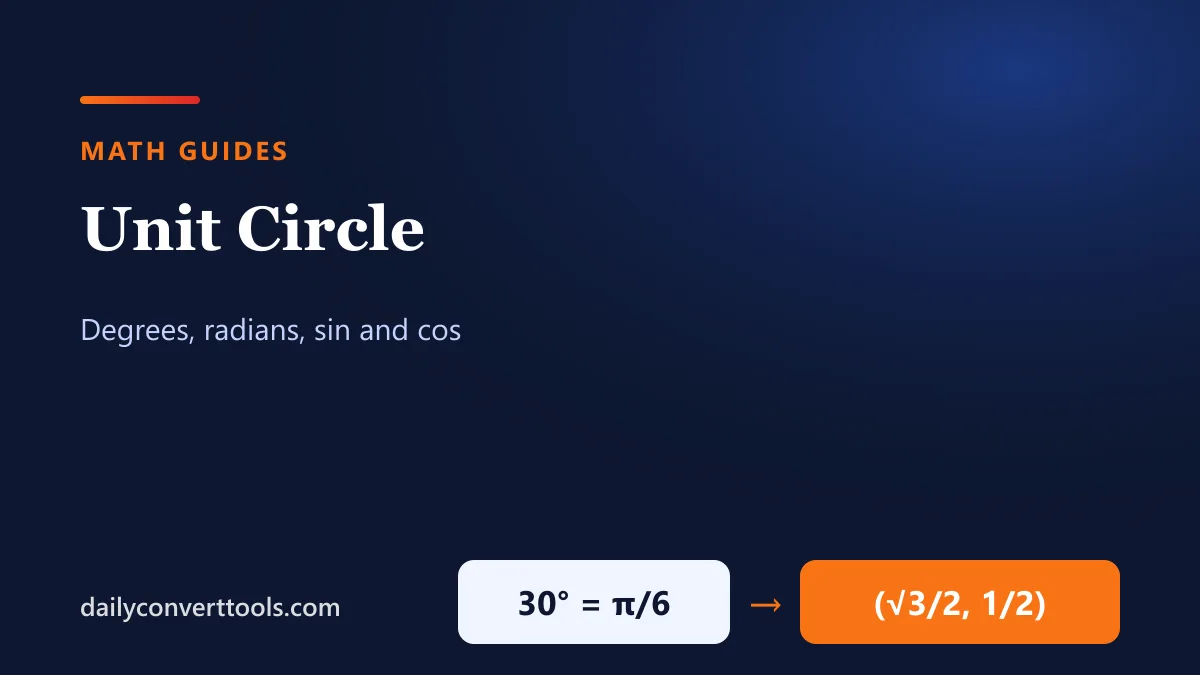
The unit circle is a circle with radius 1 centred at the origin. It’s the key to trigonometry: for any angle θ measured from the positive x-axis, the point where the angle meets the circle is (cos θ, sin θ).
Quick answer
- Every point on the unit circle is (cos θ, sin θ).
- tan θ = sin θ ÷ cos θ.
- A full turn is 360° or 2π radians; see radians to degrees.
Unit circle chart
| Degrees | Radians | cos θ (x) | sin θ (y) | tan θ |
|---|---|---|---|---|
| 0° | 0 | 1 | 0 | 0 |
| 30° | π/6 | √3/2 | 1/2 | √3/3 |
| 45° | π/4 | √2/2 | √2/2 | 1 |
| 60° | π/3 | 1/2 | √3/2 | √3 |
| 90° | π/2 | 0 | 1 | undefined |
| 120° | 2π/3 | −1/2 | √3/2 | −√3 |
| 135° | 3π/4 | −√2/2 | √2/2 | −1 |
| 150° | 5π/6 | −√3/2 | 1/2 | −√3/3 |
| 180° | π | −1 | 0 | 0 |
| 210° | 7π/6 | −√3/2 | −1/2 | √3/3 |
| 225° | 5π/4 | −√2/2 | −√2/2 | 1 |
| 240° | 4π/3 | −1/2 | −√3/2 | √3 |
| 270° | 3π/2 | 0 | −1 | undefined |
| 300° | 5π/3 | 1/2 | −√3/2 | −√3 |
| 315° | 7π/4 | √2/2 | −√2/2 | −1 |
| 330° | 11π/6 | √3/2 | −1/2 | −√3/3 |
| 360° | 2π | 1 | 0 | 0 |
How to remember it
- Learn the first quadrant (0° to 90°); every other angle is a reflection of one of these.
- The square-root pattern: sine of 0°, 30°, 45°, 60°, 90° is √0/2, √1/2, √2/2, √3/2, √4/2, that is 0, 1/2, √2/2, √3/2, 1. Cosine runs the same list backwards.
- Signs by quadrant (“All Students Take Calculus”): all positive in quadrant I, sine positive in II, tangent in III, cosine in IV.
Reference angles
To find sin 150°, use its reference angle, the acute angle to the x-axis: 180° − 150° = 30°. sin 30° = 1/2, and sine is positive in quadrant II, so sin 150° = 1/2. Similarly, cos 240° uses 240° − 180° = 60°: cos 60° = 1/2, negative in quadrant III, so cos 240° = −1/2.
Why it works
Drop a vertical line from the point to the x-axis and you get a right triangle with hypotenuse 1. Then cosine = adjacent ÷ hypotenuse = x and sine = opposite ÷ hypotenuse = y. For the triangle definitions, see SOHCAHTOA. The circle’s equation, x² + y² = 1, also gives the identity sin²θ + cos²θ = 1, which is the Pythagorean theorem again.
Decimal values
√2/2 ≈ 0.7071 and √3/2 ≈ 0.8660. Calculators must be in the right mode: sin(30) in degree mode is 0.5, but in radian mode it’s -0.9880.
Frequently asked questions
What is the unit circle?
A circle of radius 1 centred at the origin, where each point is (cos θ, sin θ).
What is sin 45°?
√2/2, about 0.7071.
What is cos 60°?
1/2.
Why is tan 90° undefined?
Because cos 90° = 0, and tan θ = sin θ ÷ cos θ divides by zero.