Reciprocal: What It Is and How to Find It (With Examples)
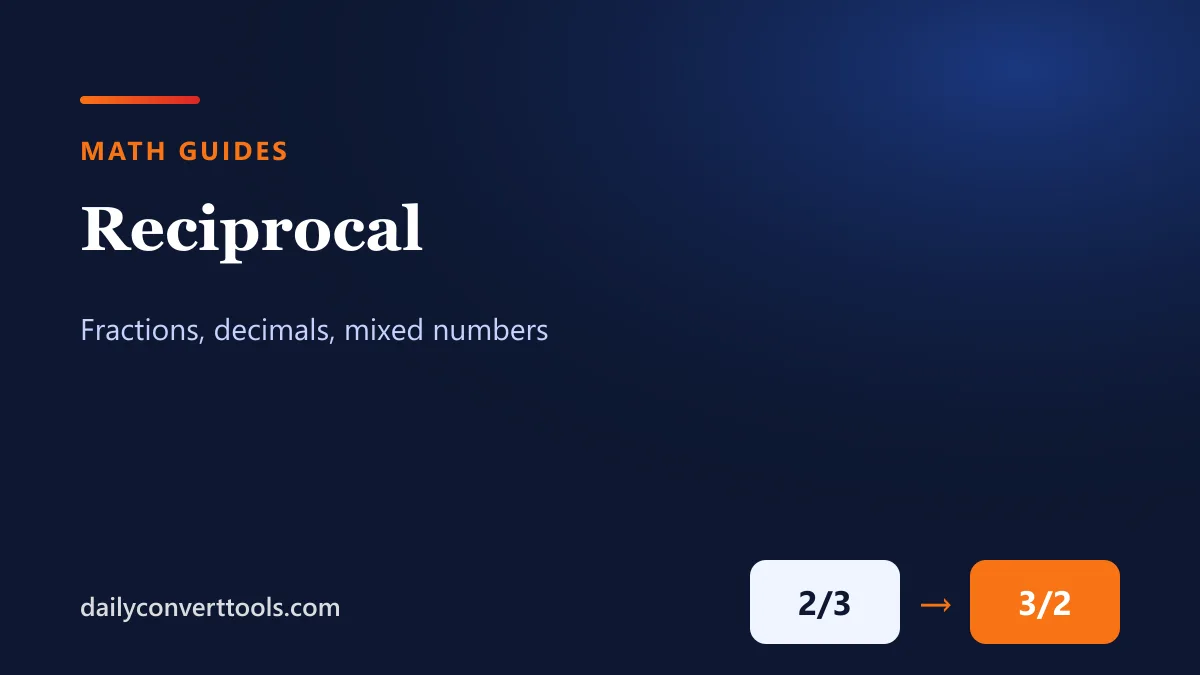
The reciprocal of a number is what you multiply it by to get 1. Mathematicians also call it the multiplicative inverse. For a fraction, you simply flip it upside down.
Quick answer
- Reciprocal of x = 1 ÷ x
- For example, 4 becomes 1/4, and 2/3 becomes 3/2.
- A number times its inverse always equals 1: 4 × 1/4 = 1.
Examples
| Number | Inverse | Check |
|---|---|---|
| 5 | 1/5 (0.2) | 5 × 0.2 = 1 |
| 1/8 | 8 | 1/8 × 8 = 1 |
| 3/4 | 4/3 | 3/4 × 4/3 = 1 |
| −2 | −1/2 | −2 × −1/2 = 1 |
| 0.25 | 4 | 0.25 × 4 = 1 |
| 2 1/2 | 2/5 | 5/2 × 2/5 = 1 |
Mixed numbers
First, convert to an improper fraction, then flip it. For instance, 2 1/2 = 5/2, so the answer is 2/5. However, don’t just flip the fraction part.
Decimals
Divide 1 by the decimal: 1 ÷ 0.4 = 2.5. Alternatively, convert to a fraction first: 0.4 = 2/5, which flips to 5/2 = 2.5. See decimal to fraction.
Why it matters: dividing fractions
In fact, dividing by a number is the same as multiplying by its inverse. So 3/4 ÷ 2/5 = 3/4 × 5/2 = 15/8 (1 7/8). This is the “keep, change, flip” rule.
Special cases
- Zero has no reciprocal, because 1 ÷ 0 is undefined.
- 1 and −1 are their own reciprocals.
- Similarly, the inverse of a negative number is also negative.
- In exponents, x−1 means 1/x; see exponents.
For more fraction skills, see how to add fractions and fraction to decimal.
Frequently asked questions
What is a reciprocal?
1 divided by the number; for a fraction, the fraction flipped upside down.
What is the reciprocal of 7?
1/7.
What is the reciprocal of 0?
Zero has no reciprocal.
What is the reciprocal of 3/5?
5/3.