Area of a Trapezoid: Formula and Worked Examples
A trapezoid (called a trapezium in the UK) is a four-sided shape with one pair of parallel sides. You’ll meet it in garden beds, roof sections, retaining walls and maths homework.
Quick answer
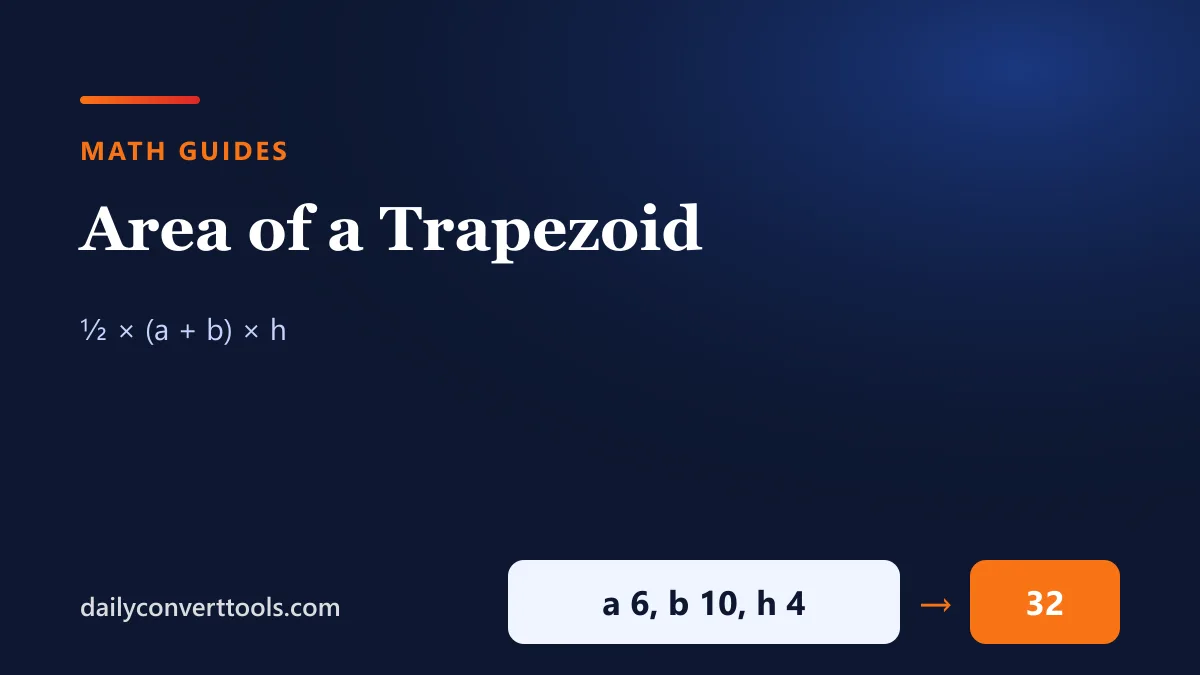
Area = ½ × (a + b) × h
- a and b are the two parallel sides (the bases).
- h is the height: the perpendicular distance between them, not a slanted side.
- Example: a = 6, b = 10, h = 4 → ½ × 16 × 4 = 32.
Why it works
The formula averages the two bases, (a + b) ÷ 2, and multiplies by the height, as if you’d turned the trapezoid into a rectangle of the same area. Another way to see it: two identical trapezoids, one flipped, fit together into a parallelogram with base (a + b) and height h. Each trapezoid is half of that.
Examples
| Base a | Base b | Height | Area |
|---|---|---|---|
| 4 | 8 | 3 | 18 |
| 5 | 9 | 6 | 42 |
| 10 | 14 | 5 | 60 |
| 2.5 | 6 | 4 | 17 |
| 12 | 20 | 7 | 112 |
Finding a missing value
- Height: h = 2 × area ÷ (a + b). An area of 45 with bases 7 and 11 gives h = 90 ÷ 18 = 5.
- A base: b = 2 × area ÷ h − a. An area of 60, height 6 and one base 8 gives b = 20 − 8 = 12.
Real-world example
A garden bed is 12 ft along the back fence, 8 ft along the path, and 5 ft deep between them. Its area is ½ × (12 + 8) × 5 = 50 sq ft. For mulch, see how much mulch do I need.
Common mistakes
- Using a slanted side as the height.
- Adding the non-parallel sides instead of the parallel ones.
- Forgetting the ½.
Other shapes: area of a triangle, area of a circle and square footage of rooms.
Frequently asked questions
What is the formula for the area of a trapezoid?
½ × (a + b) × h.
Which sides are the bases?
The two parallel sides.
Is a trapezoid the same as a trapezium?
Yes; trapezoid is the US term and trapezium the UK term for this shape.
How do I find the height of a trapezoid?
Divide twice the area by the sum of the bases.