Law of Sines: Formula, Examples and the Ambiguous Case
SOHCAHTOA only works in right triangles. The law of sines works in any triangle, linking each side to the sine of the angle opposite it.
Quick answer
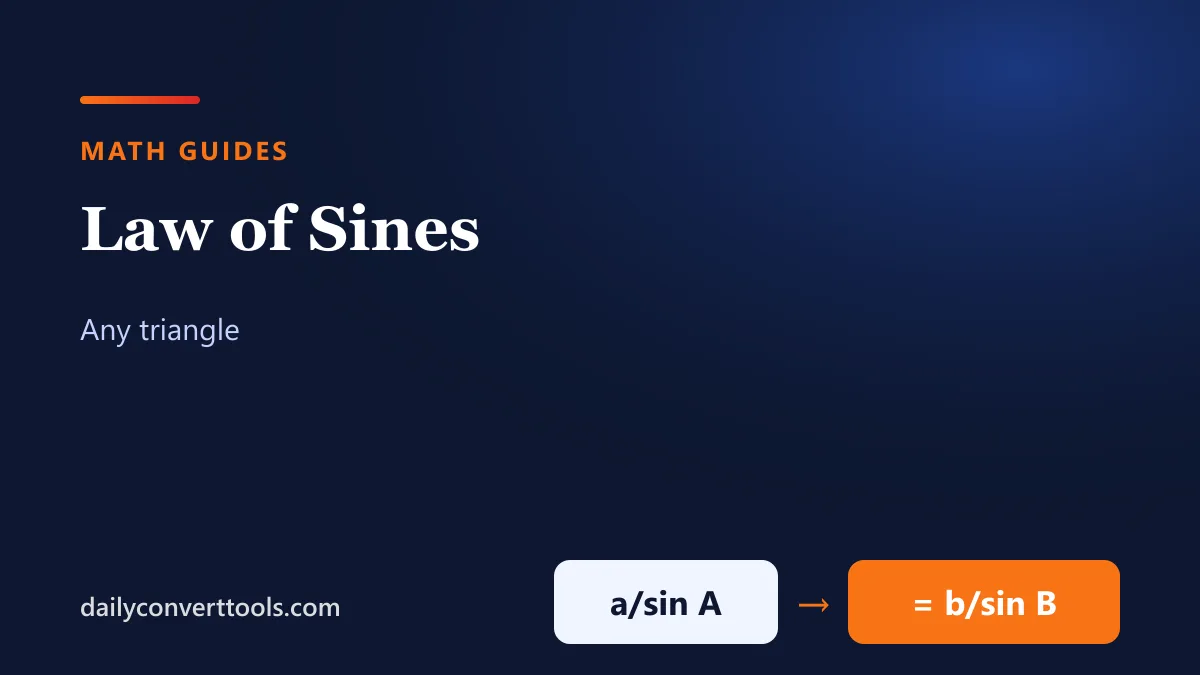
a ÷ sin A = b ÷ sin B = c ÷ sin C
Side a is opposite angle A, side b opposite B, and side c opposite C. Use any two of the three fractions together.
When to use it
- Two angles and one side (AAS or ASA): always works.
- Two sides and an angle opposite one of them (SSA): works, but check the ambiguous case below.
- Two sides and the angle between them (SAS), or three sides (SSS): use the law of cosines instead.
Example: two angles and a side
A = 40°, B = 65°, a = 10. Find the rest.
- First, the angles add to 180°: C = 180 − 40 − 65 = 75°.
- Then b = a × sin B ÷ sin A = 10 × 0.9063 ÷ 0.6428 ≈ 14.10.
- Finally, c = a × sin C ÷ sin A ≈ 15.03.
Finding an angle
If a = 8, b = 11 and B = 72°, then sin A = a × sin B ÷ b = 8 × 0.9511 ÷ 11 ≈ 0.6917, so A ≈ 43.76°.
The ambiguous case (SSA)
When you know two sides and a non-included angle, there may be zero, one or two triangles. That’s because sin θ = sin(180° − θ): if your answer for an angle is 40°, then 140° might also work. Check whether the second angle plus the known angle is under 180°. If it is, there are two possible triangles.
Example: A = 30°, a = 6, b = 10. sin B = 10 × 0.5 ÷ 6 ≈ 0.8333, so B ≈ 56.4° or B ≈ 123.6°. Both add to less than 180° with A, so two triangles fit.
Real-world use
Surveyors and navigators use the law of sines to find distances they can’t measure directly. From two points 100 m apart, if the angles to a tree across a river are 60° and 75°, the third angle is 45°, and the distance from the first point to the tree is 100 × sin 75° ÷ sin 45° ≈ 136.60 m.
For right triangles, see SOHCAHTOA; for exact sine values, the unit circle.
Frequently asked questions
What is the law of sines?
a/sin A = b/sin B = c/sin C for any triangle.
When do I use the law of sines?
When you know two angles and a side, or two sides and an angle opposite one of them.
What is the ambiguous case?
With two sides and a non-included angle, there can be zero, one or two possible triangles.
Does it work for right triangles?
Yes, though SOHCAHTOA is usually quicker there.