Volume of a Pyramid: Formula and Worked Examples
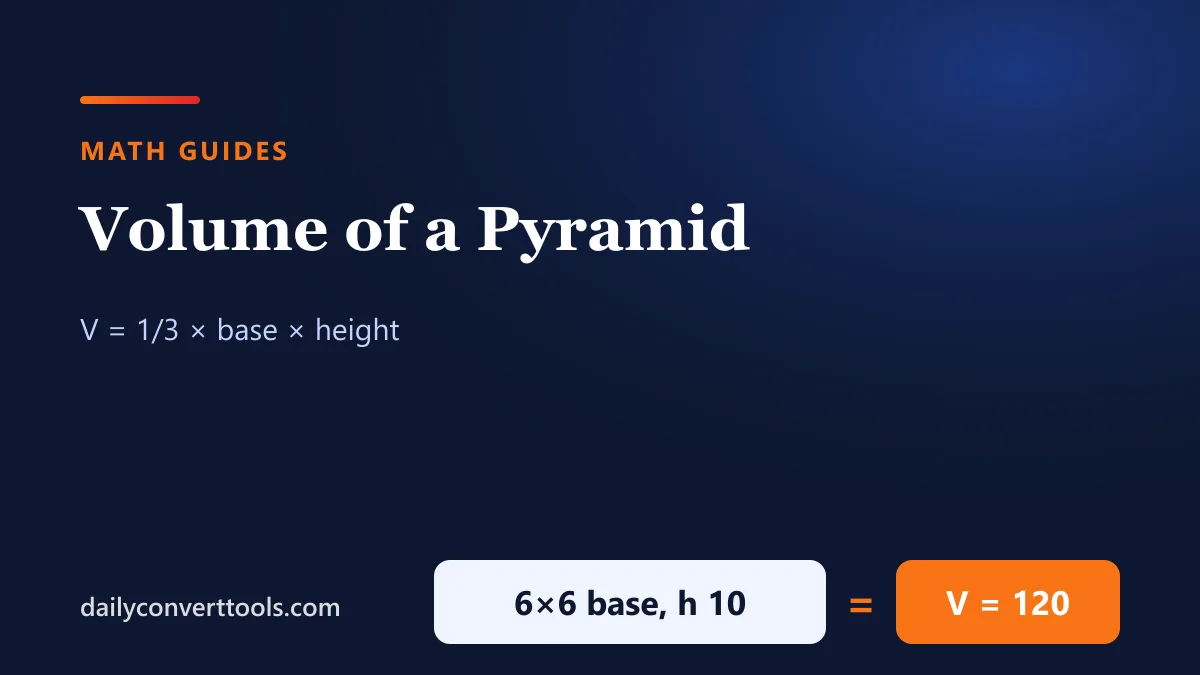
A pyramid has a flat base and triangular sides that meet at a point (the apex). Its volume is exactly one third of a prism with the same base and height, just as a cone is a third of a cylinder.
Quick answer
V = 1/3 × base area × height
Example: a square base 6 × 6 and height 10. Base area = 36, so V = 1/3 × 36 × 10 = 120 cubic units.
By base shape
| Base | Base area | Example | Volume |
|---|---|---|---|
| Square (side s) | s² | s = 4, h = 9 | 48 |
| Rectangle (l × w) | l × w | 5 × 3, h = 8 | 40 |
| Triangle | ½ × b × hbase | b = 6, base height 4, h = 10 | 40 |
| Hexagon (side s) | (3√3 ÷ 2) × s² | s = 2, h = 6 | 20.78 |
Height vs slant height
The formula needs the vertical height, from the apex straight down to the base. If you only know the slant height (down the middle of a face), use Pythagoras: for a square base of side s, h = √(slant² − (s/2)²). A square pyramid with s = 10 and slant height 13 has h = √(169 − 25) = 12, so V = 1/3 × 100 × 12 = 400.
Real-world example: the Great Pyramid
The Great Pyramid of Giza was originally about 146.6 m tall with a square base about 230.3 m on each side. That gives roughly 1/3 × 230.3² × 146.6 ≈ 2.59 million m³. (These are approximate published dimensions; erosion has since reduced its height.)
Surface area
For a square pyramid: surface area = s² + 2 × s × slant height (the base plus four triangles). With s = 10 and slant height 13: 100 + 260 = 360.
Compare with the volume of a cone and volume of a rectangular prism.
Frequently asked questions
What is the formula for the volume of a pyramid?
V = 1/3 × base area × height.
Why is it one third?
A pyramid holds exactly a third of a prism with the same base and height.
What height do I use?
The vertical height from the apex to the base, not the slant height.
What is the volume of a square pyramid with side 6 and height 10?
120 cubic units.